Real Talk 

When it comes to making a great real estate investment, knowledge is key. Our blog provides the essential information you'll need to make your next move.

Jan. 2, 2017

You Need an Agent Who Will Put You First

You Need an Agent Who Will Put You First

You Need an Agent Who Will Put You First | Keeping Current Matters

When it comes to buying a home, whether you are a rookie homebuyer or have gone through the process many times, having a local real estate expert who is well versed in the neighborhood you are looking to move into, as well as the trends of that area, should be your goal.

One great example of an agent who is in your corner and is always looking out for your best interests is one of the main characters on ABC’s Modern Family, Phil Dunphy.

For those who aren’t familiar, the character Phil is a Realtor with a huge heart who always strives to do his best for his family and his clients.

In one recent episode, Phil even shared the oath that he created and holds himself accountable to:

"On my honor, I promise to aid in man's quest for shelter, to recognize I'm not just in the business of houses -- I'm in the business of dreams in the shape of houses. To disclose all illegal additions, shoddy construction, murders, and ghosts. And to put my clients' needs before my own." 

While this might seem silly, and it was definitely written with humor in mind, the themes of helping someone achieve the American Dream and putting a client's needs above your own are not to be taken lightly. 

Bottom Line

When you make the decision to enter the housing market, as either a buyer or a seller, make sure you look for an agent who exemplifies these values and will help you through every step of the process.

Dec. 29, 2016

6 Reasons You Should Never Buy or Sell a Home Without an Agent


6 Reasons You Should Never Buy or Sell a Home Without an Agent


It’s a slow Sunday morning. You’ve just brewed your Nespresso and popped open your laptop to check out the latest home listings before you hit the road for a day of open houses.

You’re DIYing this real estate thing, and you think you’re doing pretty well—after all, any info you might need is at your fingertips online, right? That and your own sterling judgment.

–– ADVERTISEMENT ––


Oh, dear home buyer (or seller!)—we know you can do it on your own. But you really, really shouldn’t. This is likely the biggest financial decision of your entire life, and you need a Realtor® if you want to do it right. Here’s why:

1. They have loads of expertise

Want to check the MLS for a 4B/2B with an EIK and a W/DReal estate has its own language, full of acronyms and semi-arcane jargon, and your Realtor is trained to speak that language fluently.

Plus, buying or selling a home usually requires dozens of forms, reports, disclosures, and other technical documents. Realtors have the expertise to help you prepare a killer deal—while avoiding delays or costly mistakes that can seriously mess you up.

2. They have turbocharged searching power

The Internet is awesome. You can find almost anything—anything! And with online real estate listing sites such as yours truly, you can find up-to-date home listings on your own, any time you want. But guess what? Realtors have access to even more listings. Sometimes properties are available but not actively advertised. A Realtor can help you find those hidden gems.

Plus, a good local Realtor is going to know the search area way better than you ever could. Have your eye on a particular neighborhood, but it’s just out of your price range? Your Realtor is equipped to know the ins and outs of every neighborhood, so she can direct you toward a home in your price range that you may have overlooked.

3. They have bullish negotiating chops

Any time you buy or sell a home, you’re going to encounter negotiations—and as today’s housing market heats up, those negotiations are more likely than ever to get a little heated.

You can expect lots of competition, cutthroat tactics, all-cash offers, and bidding wars. Don’t you want a savvy and professional negotiator on your side to seal the best deal for you?

And it’s not just about how much money you end up spending or netting. A Realtor will help draw up a purchase agreement that allows enough time for inspections, contingencies, and anything else that’s crucial to your particular needs.

4. They’re connected to everyone

Realtors might not know everything, but they make it their mission to know just about everyone who can possibly help in the process of buying or selling a home. Mortgage brokers, real estate attorneys, home inspectors, home stagers, interior designers—the list goes on—and they’re all in your Realtor’s network. Use them.

5. They adhere to a strict code of ethics

Not every real estate agent is a Realtor, who is a licensed real estate salesperson who belongs to the National Association of Realtors®, the largest trade group in the country.

What difference does it make? Realtors are held to a higher ethical standard than licensed agents and must adhere to a Code of Ethics.

6. They’re your sage parent/data analyst/therapist—all rolled into one

The thing about Realtors: They wear a lot of different hats. Sure, they’re salespeople, but they actually do a whole heck of a lot to earn their commission. They’re constantly driving around, checking out listings for you. They spend their own money on marketing your home (if you’re selling). They’re researching comps to make sure you’re getting the best deal.

And, of course, they’re working for you at nearly all hours of the day and night—whether you need more info on a home or just someone to talk to in order to feel at ease with the offer you just put in. This is the biggest financial (and possibly emotional) decision of your life, and guiding you through it isn’t a responsibility Realtors take lightly.


Dec. 27, 2016

Homeowner's Net Worth Is 45x Greater Than A Renter's

Homeowner's Net Worth Is 45x Greater Than A Renter's

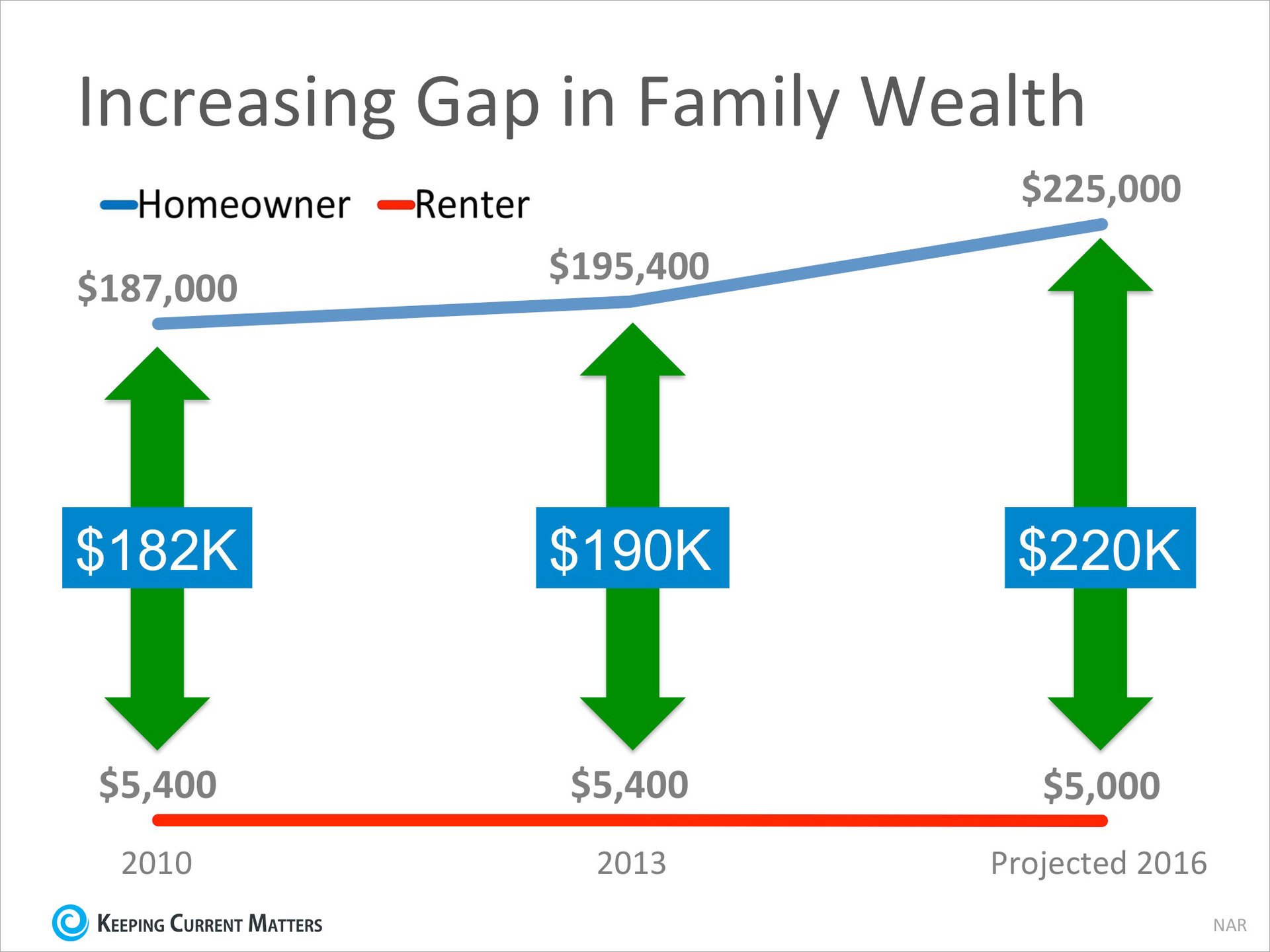
Homeowner's Net Worth Is 45x Greater Than a Renter's | Keeping Current Matters Every three years, the Federal Reserve conducts a Survey of Consumer Finances in which they collect data across all economic and social groups. The latest survey, which includes data from 2010-2013, reports that a homeowner's net worth is 36 times greater than that of a renter ($194,500 vs. $5,400). In a Forbes article, the National Association of Realtors' (NAR) Chief Economist Lawrence Yun predicts that by the end of 2016, the net worth gap will widen even further to 45 times greater. The graph below demonstrates the results of the last two Federal Reserve studies and Yun's prediction: Homeowner's Net Worth Is 45x Greater Than a Renter's | Keeping Current Matters

Put Your Housing Cost to Work for You

As we've said before, simply put, homeownership is a form of 'forced savings.' Every time you pay your mortgage, you are contributing to your net worth. Every time you pay your rent, you are contributing to your landlord's net worth. The latest National Housing Pulse Survey from NAR reveals that 85% of consumers believe that purchasing a home is a good financial decision. Yun comments: "Though there will always be discussion about whether to buy or rent, or whether the stock market offers a bigger return than real estate, the reality is that homeowners steadily build wealth. The simplest math shouldn't be overlooked."

Bottom Line

If you are interested in finding out if you could put your housing cost to work for you by purchasing a home, meet with a real estate professional in your area who can guide you through the process.
Posted in Buying a home
Dec. 22, 2016

The Fed Raised Rates: What Does that Mean for Housing?


The Fed Raised Rates: What Does that Mean for Housing?

The Fed Raised Rates: What Does that Mean for Housing? | Keeping Current Matters 

You may have heard that the Federal Reserve raised rates last week... But what does that mean if you are looking to buy a home in the near future? Many in the housing industry have predicted that the Federal Open Market Committee (FOMC), the policy-making arm of the Federal Reserve, would vote to raise the federal fund's target rate at their December meeting. For only the second time in a decade, this is exactly what happened. There were many factors that contributed to the 0.25 point increase (from 0.50 to 0.75), but many are pointing to the latest jobs report and low unemployment rate (4.6%) as the main reason. Tim Manni, Mortgage Expert at Nerd Wallet, had this tosay,

"Homebuyers shouldn't be particularly concerned with [last week's] Fed move. Even with rates hovering over 4 percent, they're still historically low. Most market observers are expecting a gradual rise in home loan rates in the near term, anticipating mortgage rates to stay under 5 percent through 2017."

Bottom Line

Only time will tell what the long-term impact of the rate hike will be, but in the short term, there should be no reason for alarm.
Posted in Getting a loan
Dec. 19, 2016

The Impact Your Interest Rate Has on Your Buying Power

The Impact Your Interest Rate Has on Your Buying Power 

The Impact Your Interest Rate Has on Your Buying Power [INFOGRAPHIC] | Keeping Current Matters

Some Highlights:

  • Your monthly housing cost is directly tied to the price of the home you purchase and the interest rate you secure for your mortgage.
  • Over the last 30 years, interest rates have fluctuated greatly with rates in the double digits in the 1980s, all the way down to the near 4% we are experiencing now.
  • Your purchasing power is greatly impacted by the interest rate you secure. Act now before rates go up!
Posted in Getting a loan
Dec. 14, 2016

The #1 Reason to Sell Now...Not Next Spring

The #1 Reason to Sell Now… Not Next Spring


The #1 Reason to Sell Now… Not Next Spring | Keeping Current Matters

The price of any item (including residential real estate) is determined by ‘supply and demand’. If many people are looking to buy an item and the supply of that item is limited, the price of that item increases.

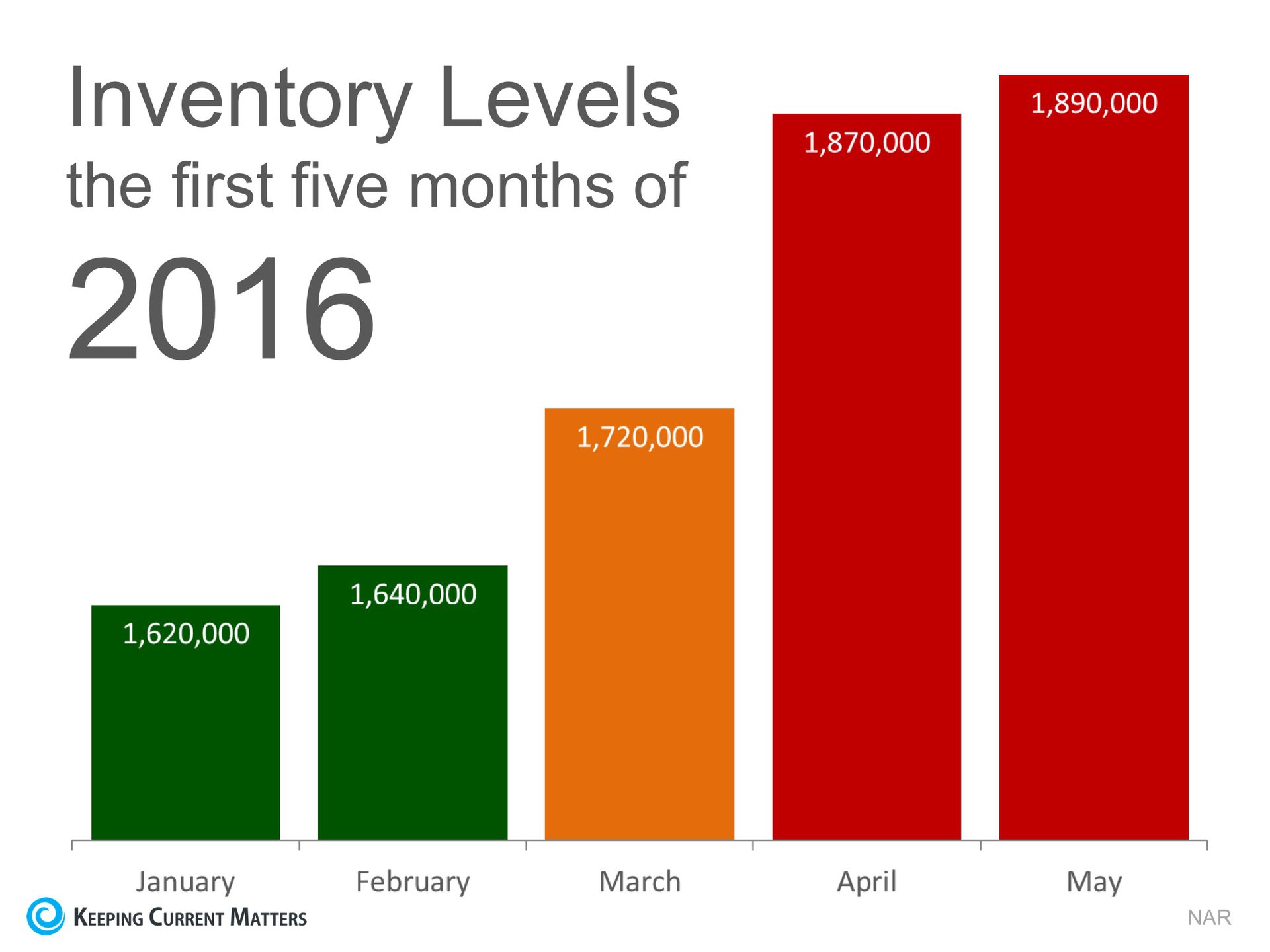
According to the National Association of Realtors (NAR), the supply of homes for sale dramatically increases every spring. As an example, here is what happened to housing inventory at the beginning of 2016:

The #1 Reason to Sell Now… Not Next Spring | Keeping Current Matters

Putting your home on the market now instead of waiting for increased competition in the spring might make a lot of sense.

Bottom Line

Buyers in the market during the winter months are truly motivated purchasers. They want to buy now. With limited inventory currently available in most markets, sellers are in a great position to negotiate.

Posted in Selling Your Home
Dec. 13, 2016

Building Your Family's Wealth

Building Your Family’s Wealth Over the Next 5 Years

Building Your Family’s Wealth Over the Next 5 Years | Keeping Current Matters

Over the next five years, home prices are expected to appreciate 3.24% per year on average and to grow by 21.4% cumulatively, according to Pulsenomics’ most recent Home Price Expectation Survey.

So, what does this mean for homeowners and their equity position?

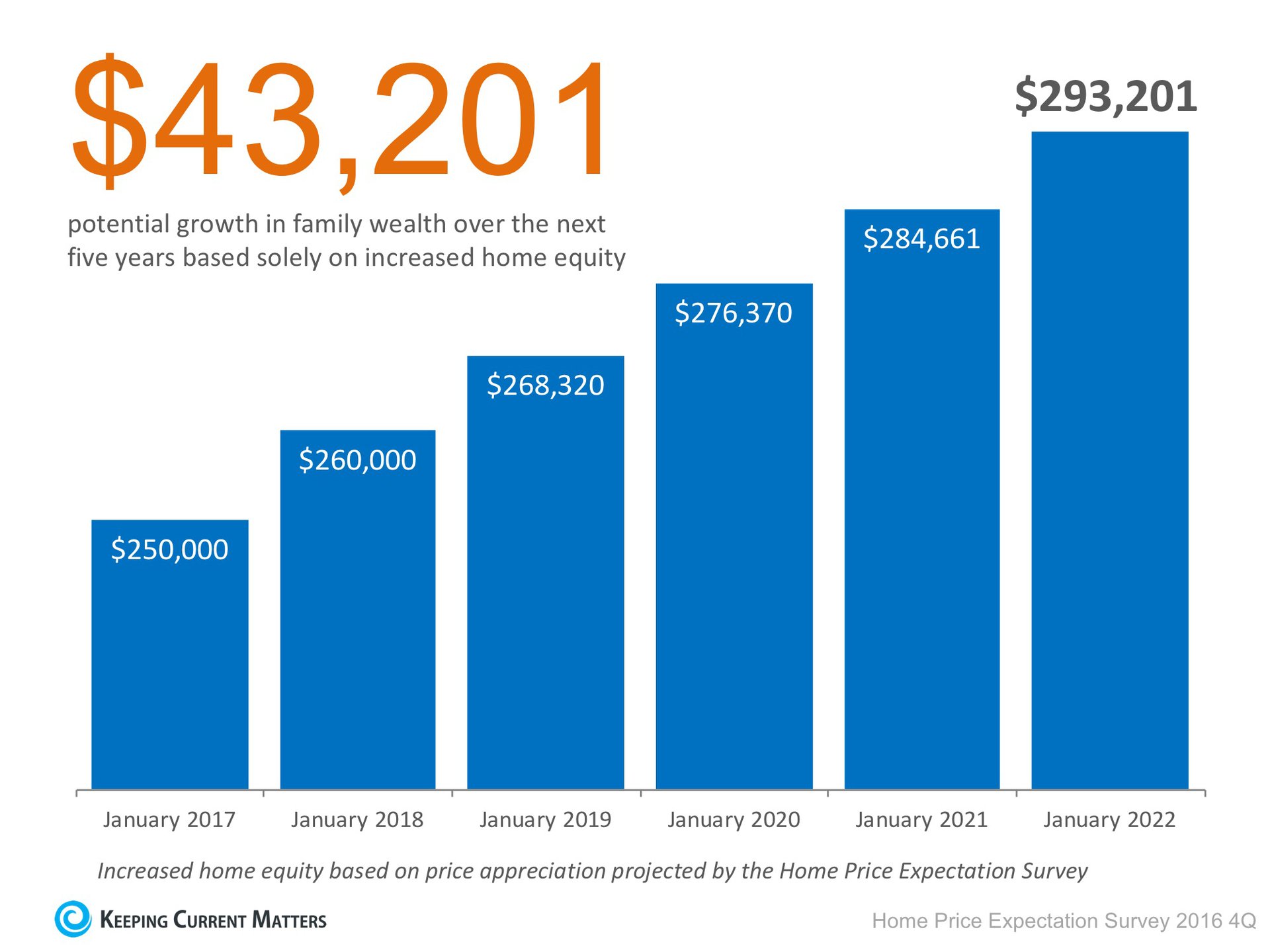
As an example, let’s assume a young couple purchases and closes on a $250,000 home in January. If we look at only the projected increase in the price of that home, how much equity will they earn over the next 5 years?

Building Your Family’s Wealth Over the Next 5 Years | Keeping Current Matters

Since the experts predict that home prices will increase by 4.0% this year alone, the young homeowners will have gained over $10,000 in equity in just one year.

Over a five-year period, their equity will increase by over $43,000! This figure does not even take into account their monthly principal mortgage payments. In many cases, home equity is one of the largest portions of a family’s overall net worth.

Bottom Line

Not only is homeownership something to be proud of, but it also offers you and your family the ability to build equity you can borrow against in the future. If you are ready and willing to buy, find out if you are able to, today.

Posted in Home Equity
Dec. 1, 2016

5 Reasons Why Homeownership Is a Good Financial Investment

5 Reasons Why Homeownership Is a Good Financial Investment


According to a recent report by Trulia, “buying is cheaper than renting in 100 of the largest metro areas by an average of 37.7%.” That may have some thinking about buying a home instead of signing another lease extension. But, does that make sense from a financial perspective?

In the report, Ralph McLaughlin, Trulia’s Chief Economist explains:

“Owning a home is one of the most common ways households build long-term wealth, as it acts like a forced savings account. Instead of paying your landlord, you can pay yourself in the long run through paying down a mortgage on a house.”

The report listed five reasons why owning a home makes financial sense:

  1. Mortgage payments can be fixed while rents go up.
  2. Equity in your home can be a financial resource later.
  3. You can build wealth without paying capital gains.
  4. A mortgage can act as a forced savings account.
  5. Overall, homeowners can enjoy greater wealth growth than renters.

Bottom Line

Before you sign another lease, perhaps you should sit with a real estate professional in your area to better understand all your options.

Posted in Buying a home
May 31, 2016

What You Really Need To Qualify For A Mortgage

What You Really Need To Qualify For A Mortgage

What You Really Need To Qualify For A Mortgage | Simplifying The Market

A recent survey by Ipsos found that the American public is still somewhat confused about what is actually necessary to qualify for a home mortgage loan in today’s housing market. The study pointed out two major misconceptions that we want to address today.

1. Down Payment

The survey revealed that consumers overestimate the down payment funds needed to qualify for a home loan. According to the report, 36% think a 20% down payment is always required. In actuality, there are many loans written with a down payment of 5% or less.

Below are the results of a Digital Risk survey done on Millennials who recently purchased a home.

Down Payments | Simplifying The Market

2. FICO Scores

The Ipsos survey also reported that two-thirds of the respondents believe they need a very good credit score to buy a home, with 45 percent thinking a “good credit score” is over 780. In actuality, the average FICO scores of approved conventional and FHA mortgages are much lower.

Below are the numbers from the latest Ellie Mae report.

FICO Scores | Simplifying The Market

Bottom Line

If you are a prospective purchaser who is ‘ready’ and ‘willing’ to buy but not sure if you are also ‘able,’ let's get together and discuss your options.

Posted in Loan Options
May 28, 2016

Millennials Changing Face of America, Heavily Impacting Homeownership, Say Experts

Millennials Changing Face of America, Heavily Impacting Homeownership, Say Experts

WASHINGTON (May 13, 2016) — Millennials are bucking trends, changing the landscape of America, and sharply different from previous generations in many different ways. One of the most visible and consequential ways is through millennial homeownership numbers, according to experts on generational trends and homeownership presenting at the 2016 REALTORS® Legislative Meetings & Trade Expo.


While all generations have their own hardships, opportunities and defining features, millennials are coming of age in a time of deep demographic transformation, experts say. In a session titled "The Minds of Millennials—Motivation, Mobility and Making  Home," presented by REALTOR® University and moderated by National Association of Realtors® Chief Economist Lawrence Yun, panelists discussed what the shift means for the American way of life.


"America in the near future will look nothing like the America of the past," said Paul Taylor, executive vice president of the Pew Research Center and author of the book "The Next America: Boomers, Millennials, and the Looming Generational Showdown". "These shifts are creating big generation gaps that will put stress on our families, our politics, our pocketbooks, our entitlements programs and perhaps our social cohesion."


Millennials, Taylor said, are different from their parents and grandparents in ways that are already impacting all aspects of life. For example, he noted that millennials (those born after 1980) are less religiously affiliated and slow to marry and have kids. They grew up with cell phones and on social networking sites while also obtaining a high level of education, but are still struggling financially because of the economy. Politically, half of the generation identifies as independent, more than ever have before. While seemingly small differences, these characteristics have very real effects on homeownership. After all, he noted, 39 percent of millennials are still living with a parent or relative, citing the record share of young households holding student debt.


Jessica Lautz, managing director of survey research at NAR, agreed that homeownership among millennials is taking a hit. Student loan debt, flat wages, rising home prices (making it harder to get into the homeownership game) and rising rents (complicating the saving process), are delaying milestones such as marrying and having children - major events in life that often cause young people to buy a home.


The real estate industry is already feeling the impact of these factors on millennials in regards to home buying.  First-time buyers have in the past accounted for about 40 percent of homebuyers; however, NAR data show that number has trended downward since 2011 and currently sits at 32 percent. And while married couples are the largest group of buyers (currently 67 percent of all buyers), single females make up the second largest group of buyers, and that share has also dropped from 22 percent in 2006 to 15 percent in 2015.


Still, one big thing hasn't changed, according to Lautz. "Even with all these statistics showing how things have changed for millennials and the fact that they are worse off financially than previous generations had been, the median age of first-time buyers has stayed relatively unchanged at 31," Lautz said. "This means that they are ready and willing to buy if they can in fact break into the market. It's getting more difficult to get to that point, but the desire to do so hasn't changed."


And while the path to homeownership is harder now for millennials carrying student debt, dealing with rising rents, and experiencing stagnant wages, NAR research shows that millennials still see the value in owning and home and once they are ready, they are looking to a real estate agent in higher numbers than ever before.


"We are seeing that millennials are using agents at much higher rates," Lautz said. "You might assume that they would prefer to take on a purchase or sell on their own, being raised in the digital age, but instead, we have found that these buyers and sellers want someone to help them through the process, not unlike the way their parents have helped them through their young adult life. Not having been through the process before, they rely on real estate agents to get them through the competitive market and to the finish line."


The National Association of Realtors®, "The Voice for Real Estate," is America's largest trade association, representing 1.1 million members involved in all aspects of the residential and commercial real estate industries.