Real Talk 

When it comes to making a great real estate investment, knowledge is key. Our blog provides the essential information you'll need to make your next move.

May 11, 2017

Do You Know the Cost of Waiting?

Do You Know the Cost of Waiting? [INFOGRAPHIC] | Keeping Current Matters

Some Highlights:

  • The “Cost of Waiting to Buy” is defined as the additional funds it would take to buy a home if prices and interest rates were to increase over a period of time.
  • Freddie Mac predicts that interest rates will increase to 4.8% by this time next year, while home prices are predicted to appreciate by 4.9% according to CoreLogic.
  • Waiting until next year to buy could cost you thousands of dollars a year for the life of your mortgage!
Posted in Buying a home
May 4, 2017

Financial Planning: 4 Reasons to Buy a House Today


Financial Planning: 4 Reasons to Buy a House Today | Keeping Current Matters

Homeownership will always be a part of the American Dream. There are advantages to owning your own home (educationalhealthsocial) that far transcend any economic impact. However, we want to look at several of the financial advantages of homeownership in today’s post.

1. Buying is Cheaper Than Renting

The results of the latest Rent vs. Buy Report from Trulia show that homeownership remains cheaper than renting with a traditional 30-year fixed rate mortgage in the 100 largest metro areas in the United States. The report reveals that:

“Interest rates have remained low, and even though home prices have appreciated around the country, they haven’t greatly outpaced rental appreciation…Nationally, rates would have to reach 9.1% for renting to be cheaper than buying. Rates haven’t been that high since January of 1995, according to Freddie Mac.”

2. Homeownership “Forces” You to Save

According to SavingAdvice.com, homeownership is a great way to save. Their advice is quite simple:

“Homeownership is a “forced” savings account because you own the home, you have no choice – that monthly housing cost has got to be paid no matter what…Homeownership can be an outstanding way to force yourself to be more frugal in the rest of your spending so that you can save and build equity in your home.”

3. Homeownership Offers Several Tax Deductions

According to the Tax Policy Center’s Briefing Book -“A citizen's guide to the fascinating (though often complex) elements of the federal Tax System” - there are several tax advantages to homeownership. Here are three:

  1. Homeowners who itemize deductions may reduce their taxable income by deducting any interest paid on a home mortgage.
  2. Homeowners who itemize deductions may also reduce their taxable income by deducting property taxes they pay on their homes.
  3. Taxpayers who sell assets must generally pay capital gains tax on any profits made on the sale.

4. Experts Expect Home Price Appreciation to Continue

Every quarter, Pulsenomics surveys a nationwide panel of over one hundred economists, real estate experts, and investment & market strategists about where they believe prices are headed over the next five years. They then average the projections of all 100+ experts into a single number.

Over the next five years, home prices are expected to appreciate 3.22% per year on average and to grow by 17.3% cumulatively, according to Pulsenomics’ most recent Home Price Expectation Survey.

Bottom Line

Some are afraid that home values may have already peaked. However, we believe that purchasing a home now will prove to be a sound financial decision for years to come. As Warren Buffet said, “When others are greedy, be fearful. When others are fearful, be greedy.”


Posted in Buying a home
April 24, 2017

Thinking of Selling? Now Is the Time to Act

Thinking of Selling? Now Is the Time to Act | Keeping Current Matters

If you thought about selling your house this year, now may be the time to do it. The inventory of homes for sale is well below historic norms and buyer demand is skyrocketing. We were still in high school when we learned the concept of supply and demand: the best time to sell something is when supply of that item is low and demand for that item is high. That defines today’s real estate market.

Jonathan Smoke, Chief Economist at realtor.com, revealed in a recent article that:

“The biggest challenge to buyers this spring will be simply finding a home to buy and getting it successfully under contract. That’s because the supply of homes for sale is at an all-time low, and yet demand is strong and getting stronger.”

Smoke goes on to say:

“We started the year with the lowest inventory of homes available for sale that we’ve ever seen on realtor.com. While we did see inventory grow 2% in February, total inventory was down 11% over last year.”

In this type of market, a seller may hold a major negotiating advantage when it comes to price and other aspects of the real estate transaction including the inspection, appraisal and financing contingencies.

Bottom Line

As a potential seller, you are in the driver’s seat right now. It might be time to hit the gas.

Posted in Selling Your Home
April 21, 2017

Tax Return Depressing? Owning a Home Could Help

Tax Return Depressing? Owning a Home Could Help | Keeping Current Matters

Many Americans got some depressing news last week; either their tax return was not as large as they had hoped or, in some cases, they were told they owed additional money to either the Federal or State government or both. One way to save on taxes is to own your own home.

According to the Tax Policy Center’s Briefing Book -“A citizen's guide to the fascinating (though often complex) elements of the federal Tax System” - there are several tax advantages to homeownership.

Here are four items, and a quote on each, from the Briefing Book:

1. Mortgage Interest Deduction

“Homeowners who itemize deductions may reduce their taxable income by deducting any interest paid on a home mortgage. The deduction is limited to interest paid on up to $1 million of debt incurred to purchase or substantially rehabilitate a home. Homeowners also may deduct interest paid on up to $100,000 of home equity debt, regardless of how they use the borrowed funds. Taxpayers who do not own their home have no comparable ability to deduct interest paid on debt incurred to purchase goods and services.”

2. Property Tax Deduction

“Homeowners who itemize deductions may also reduce their taxable income by deducting property taxes they pay on their homes.”

3. Imputed Rent

“Buying a home is an investment, part of the returns from which is the opportunity to live in the home rent-free. Unlike returns from other investments, the return on homeownership—what economists call “imputed rent”—is excluded from taxable income. In contrast, landlords must count as income the rent they receive, and renters may not deduct the rent they pay. A homeowner is effectively both landlord and renter, but the tax code treats homeowners the same as renters while ignoring their simultaneous role as their own landlords.”

4. Profits from Home Sales

“Taxpayers who sell assets must generally pay capital gains tax on any profits made on the sale. But homeowners may exclude from taxable income up to $250,000 ($500,000 for joint filers) of capital gains on the sale of their home if they satisfy certain criteria: they must have maintained the home as their principal residence in two out of the preceding five years, and they generally may not have claimed the capital gains exclusion for the sale of another home during the previous two years.”

Bottom Line

We are not suggesting that you purchase a house just to save on your taxes. However, if you have been on the fence as to whether 2017 is the year you should become a homeowner, this information might help with that decision.

Disclaimer: Always check with your accountant to find out what tax advantages apply to you in your area. 

March 28, 2017

The Foreclosure Crisis: 10 Years Later

The Foreclosure Crisis: 10 Years Later | Keeping Current Matters

CoreLogic recently released a report entitled, United States Residential Foreclosure Crisis: 10 Years Later, in which they examined the years leading up to the crisis all the way through to present day.

With a peak in 2010 when nearly 1.2 million homes were foreclosed on, over 7.7 million families lost their homes throughout the entire foreclosure crisis.

Dr. Frank Nothaft, Chief Economist for CoreLogic, had this to say,

“The country experienced a wild ride in the mortgage market between 2008 and 2012, with the foreclosure peak occurring in 2010. As we look back over 10 years of the foreclosure crisis, we cannot ignore the connection between jobs and homeownership. A healthy economy is driven by jobs coupled with consumer confidence that usually leads to homeownership.”

Since the peak, foreclosures have been steadily on the decline by nearly 100,000 per year all the way through the end of 2016, as seen in the chart below.

The Foreclosure Crisis: 10 Years Later | Keeping Current Matters

If this trend continues, the country will be back to 2005 levels by the end of 2017.

Bottom Line

As the economy continues to improve, and employment numbers increase, the number of completed foreclosures should continue to decrease.

March 10, 2017

Spring Forward: The Difference An Hour Makes


Spring Forward: The Difference An Hour Makes [INFOGRAPHIC] | Keeping Current Matters

Some Highlights:

  • Don’t forget to set your clocks forward this Sunday, March 12th at 2:00 AM EST in observance of Daylight Savings Time.
  • Unless of course, you are a resident of Arizona or Hawaii!
  • Every hour in the United States: 649 homes are sold, 177 homes regain equity (meaning they are no longer underwater on their mortgage), and the median home price rises $1.86

March 7, 2017

Thinking of Selling? Do it TODAY!!


Thinking of Selling? Do it TODAY!! | Keeping Current Matters

That headline might be a little aggressive. However, as the data on the 2017 housing market begins to roll in, we can definitely say one thing: If you are considering selling, IT IS TIME TO LIST YOUR HOME!

The February numbers are not in yet, but the January numbers were sensational. Lawrence Yun, Chief Economist for the National Association of Realtors, said:

“Much of the country saw robust sales activity last month as strong hiring and improved consumer confidence at the end of last year appear to have sparked considerable interest in buying a home. Market challenges remain, but the housing market is off to a prosperous start as homebuyers staved off inventory levels that are far from adequate…”

And CNBC says consumer confidence in the economy is fueling the market:

“U.S. home resales surged to a 10-year high in January as buyers shrugged off higher prices and mortgage rates, a sign of growing confidence in the economy.”

The only challenge to the market is a severe lack of inventory. A balanced market would have a full six-month supply of homes for sale. Currently, there is less than a four-month supply of inventory. This represents a decrease in supply of 7.1% from the same time last year.

Bottom Line

With demand increasing and supply dropping, this may be the perfect time to get the best price for your home. Contact a local real estate professional today to see whether that is the case in your neighborhood

Posted in Selling Your Home
Feb. 20, 2017

US Housing Market Is Moving into ‘Buy Territory’!

US Housing Market Is Moving into 'Buy Territory'! | Keeping Current Matters

According to the Beracha, Hardin & Johnson Buy vs. Rent (BH&J) Index, the U.S. housing market has continued to move deeper into buy territory, supporting the belief that housing markets across the country remain a sound investment.

The BH&J Index is a quarterly report that attempts to answer the question:

In today’s housing market, is it better to rent or buy a home?

The index examines the entire US housing market and then isolates 23 major cities for comparison. The researchers “measure the relationship between purchasing property and building wealth through a buildup in equity versus renting a comparable property and investing in a portfolio of stocks and bonds.” 

While most of the metropolitan markets examined moved further into buy territory (16 of the 23), markets like Dallas, Denver, and Houston are currently deep into rent territory. In these three markets, it is estimated that renting will top homeownership 7 out of 10 times.

Due to a lack of inventory, the home prices in the Dallas, Denver, and Houston areas have increased by 11.6%8.3%, and 6.6% respectively. Home prices in these areas will begin to return to more normal levels once residents realize that renting is not the best option, therefore bringing home affordability back as well.

Bottom Line

The majority of the country is strongly in buy territory. Buying a home makes sense socially and financially, as rents are predicted to increase substantially in the next year. Protect yourself from rising rents by locking in your housing cost with a mortgage payment now.

To Find Out More About the Study: The BH&J Index and other FAU real estate activities are sponsored by Investments Limited of Boca Raton. The BH&J Index is published quarterly and is available online at http://business.fau.edu/buyvsren
t

Feb. 15, 2017

The Great News About Rising Prices for Homeowners

The Great News About Rising Prices for Homeowners | Keeping Current Matters

Recently there has been a lot of talk about home prices and if they are accelerating too quickly. As we mentioned before, in some areas of the country, seller supply (homes for sale) cannot keep up with the number of buyers out looking for a home, which has caused prices to rise.

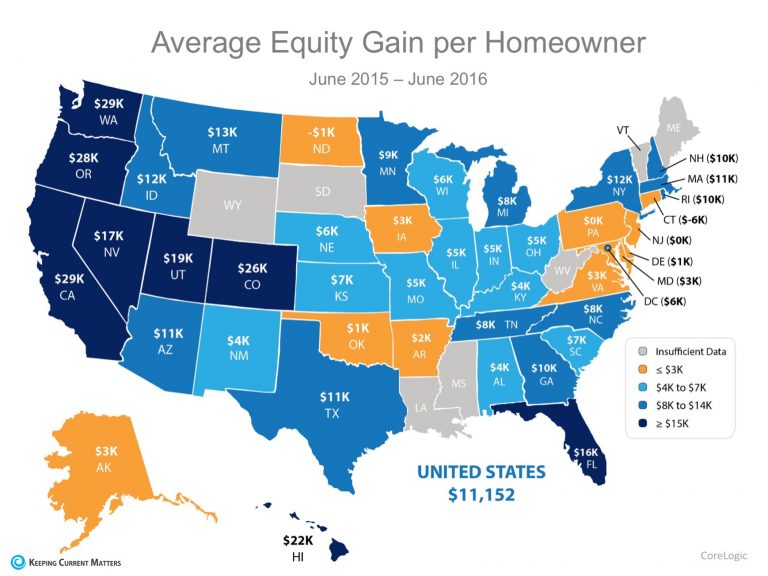
The great news about rising prices, however, is that according to CoreLogic’s US Economic Outlook, the average American household gained over $11,000 in equity over the course of the last year, largely due to home value increases.

The map below was created using the same report from CoreLogic and shows the average equity gain per mortgaged home from June 2015 to June 2016 (the latest data available).

The Great News About Rising Prices for Homeowners | Keeping Current Matters

For those who are worried that we are doomed to repeat 2006 all over again, it is important to note that homeowners are investing their new-found equity in their homes and themselves, not in depreciating assets.

The added equity is helping families put their children through college, invest in starting small businesses, allowing them to pay off their mortgage sooner or move up to the home that will better suit their needs now.

Bottom Line

CoreLogic predicts that home prices will appreciate by another 5% by this time next year. If you are a homeowner looking to take advantage of your home equity by moving up to your dream home, contact an agent in your area to discuss your options!

Feb. 7, 2017

Buyer Demand Is Outpacing the Supply of Homes for Sale

Buyer Demand Is Outpacing the Supply of Homes for Sale | Keeping Current Matters

The price of any item is determined by the supply of that item, as well as the market demand. The National Association of REALTORS (NAR) surveys “over 50,000 real estate practitioners about their expectations for home sales, prices and market conditions” for their monthly REALTORS Confidence Index.

Their latest edition sheds some light on the relationship between Seller Traffic (supply) and Buyer Traffic (demand).

Buyer Demand

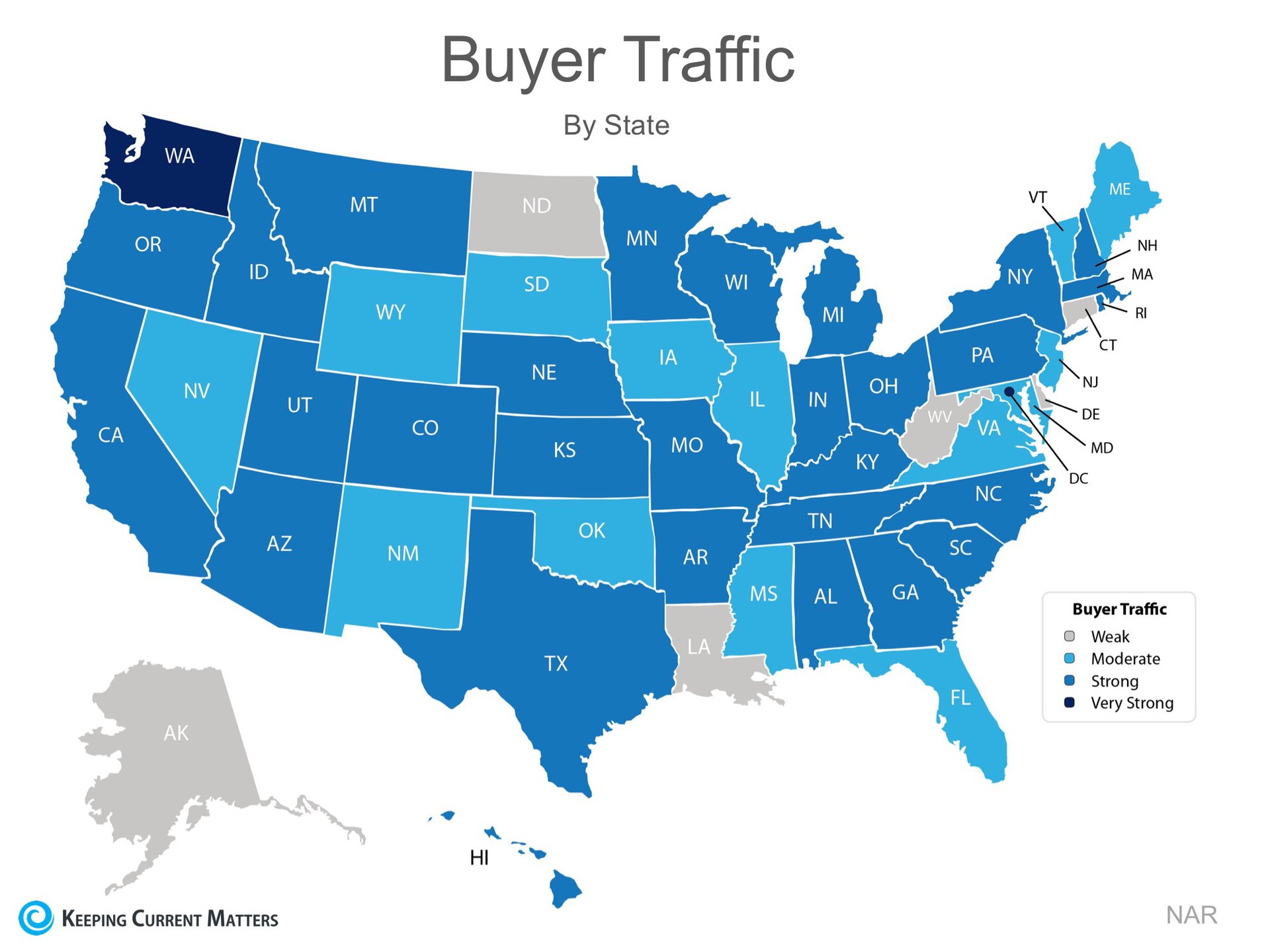
The map below was created after asking the question: “How would you rate buyer traffic in your area?”

Buyer Demand Is Outpacing the Supply of Homes for Sale | Keeping Current Matters

The darker the blue, the stronger the demand for homes in that area. Only six states had a weak demand level.

Seller Supply

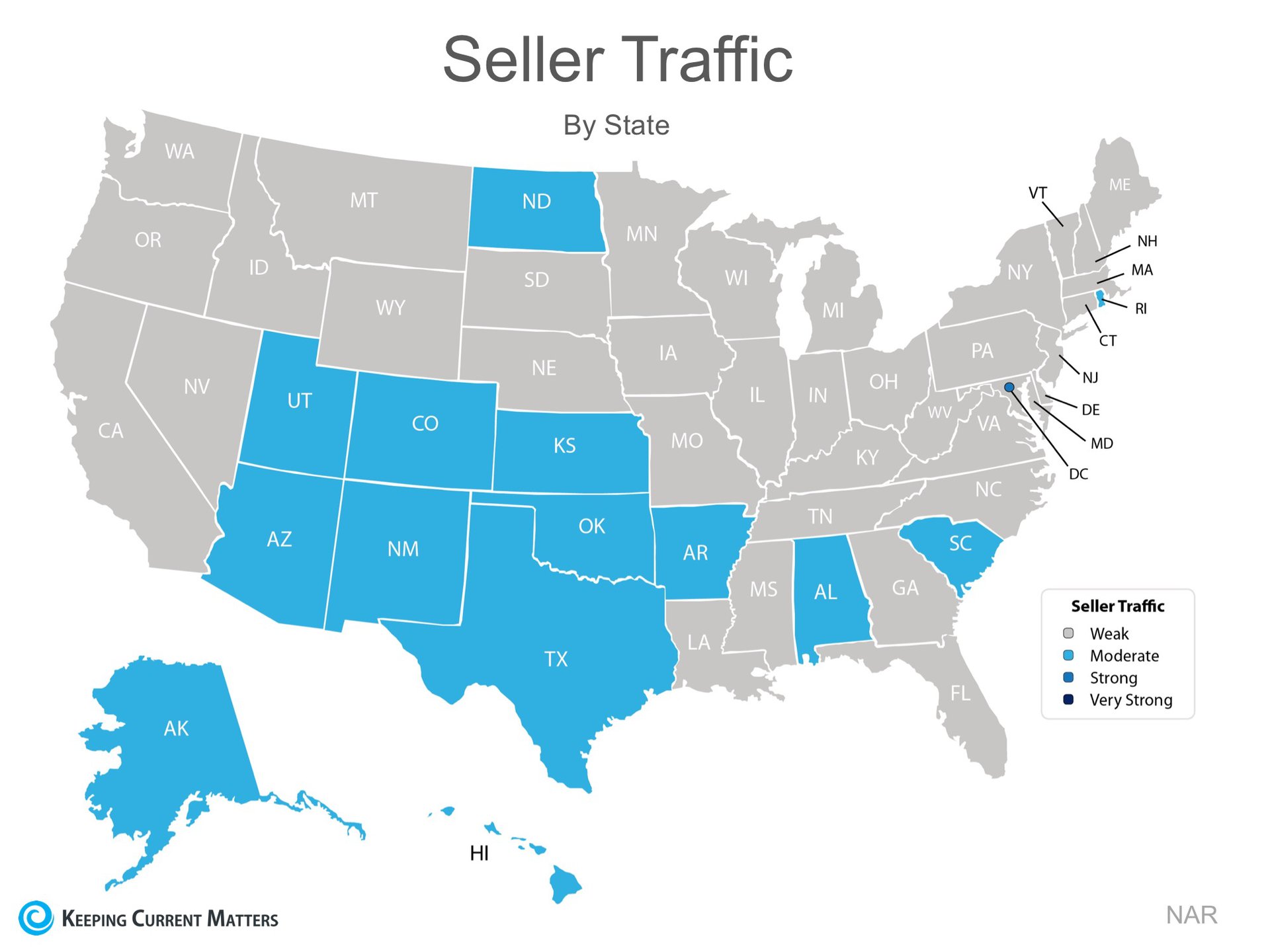
The Index also asked: “How would you rate seller traffic in your area?”

As you can see from the map below, the majority of the country has weak Seller Traffic, meaning there are far fewer homes on the market than what is needed to satisfy the buyers who are out looking for their dream homes.

Buyer Demand Is Outpacing the Supply of Homes for Sale | Keeping Current Matters

Bottom Line

Looking at the maps above, it is not hard to see why prices are appreciating in many areas of the country. Until the supply of homes for sale starts to meet the buyer demand, prices will continue to increase. If you are debating listing your home for sale, meet with a local real estate professional in your area who can help you capitalize on the demand in the market now!