Real Talk 

When it comes to making a great real estate investment, knowledge is key. Our blog provides the essential information you'll need to make your next move.

Dec. 27, 2018

4 REASONS WHY WE ARE NOT HEADING TOWARD ANOTHER HOUSING BUBBLE

4 Reasons Why We Are Not Heading Toward Another Housing Bubble

 

4 Reasons Why We Are Not Heading Toward Another Housing Bubble

With home prices continuing to appreciate above historic levels, some are concerned that we may be heading for another housing ‘boom & bust.’ It is important to remember, however, that today’s market is quite different than the bubble market of twelve years ago.

Here are four key metrics that will explain why:

    1. Home Prices
    2. Mortgage Standards
    3. Foreclosure Rates
    4. Housing Affordability

1. HOME PRICES

There is no doubt that home prices have reached 2006 levels in many markets across the country. However, after more than a decade, home prices should be much higher based on inflation alone.

Last week, CoreLogic reported that,

“The inflation-adjusted U.S. median sale price in June 2006 was $247,110 (or $199,899 in 2006 dollars), compared with $213,400 in March 2018.” (This is the latest data available.)

2. MORTGAGE STANDARDS

Many are concerned that lending institutions are again easing standards to a level that helped create the last housing bubble. However, there is proof that today’s standards are nowhere near as lenient as they were leading up to the crash.

The Urban Institute’s Housing Finance Policy Center issues a monthly index which,

“…measures the percentage of home purchase loans that are likely to default—that is, go unpaid for more than 90 days past their due date. A lower HCAI indicates that lenders are unwilling to tolerate defaults and are imposing tighter lending standards, making it harder to get a loan. A higher HCAI indicates that lenders are willing to tolerate defaults and are taking more risks, making it easier to get a loan.”

Their July Housing Credit Availability Index revealed:

“Significant space remains to safely expand the credit box. If the current default risk was doubled across all channels, risk would still be well within the pre-crisis standard of 12.5 percent from 2001 to 2003 for the whole mortgage market.”

3. FORECLOSURE RATES

A major cause of the housing crash last decade was the number of foreclosures that hit the market. They not only increased the supply of homes for sale but were also being sold at 20-50% discounts. Foreclosures helped drive down all home values.

Today, foreclosure numbers are lower than they were before the housing boom. Here are the number of consumers with new foreclosures according to the Federal Reserve’s most recent Household Debt and Credit Report:

  • 2003: 203,320 (earliest reported numbers)
  • 2009: 566,180 (at the valley of the crash)
  • Today: 76,480

Foreclosures today are less than 40% of what they were in 2003.

4. HOUSING AFFORDABILITY

Contrary to many headlines, home affordability is better now than it was prior to the last housing boom. In the same article referenced in #1, CoreLogic revealed that in the vast majority of markets, “the inflation-adjusted, principal-and-interest mortgage payments that homebuyers have committed to this year remain much lower than their pre-crisis peaks.”

They went on to explain:

“The main reason the typical mortgage payment remains well below record levels in most of the country is that the average mortgage rate back in June 2006, when the U.S. typical mortgage payment peaked, was about 6.7 percent, compared with an average mortgage rate of about 4.4 percent in March 2018.”

The “price” of a home may be higher, but the “cost” is still below historic norms.

Bottom Line

After using these four key housing metrics to compare today to last decade, we can see that the current market is not anything like that bubble market.

 

Posted in Market Conditions
Oct. 30, 2018

Pay Off Your Mortgage Early

Pay Off Your Mortgage Early: Easy Tricks Anyone Can Use


There are two ways to own your home. Either you can pay cash upfront or you can pay little by little, year after year. For most us, monthly mortgage payments are the most feasible option. While we continue to chip away paying off our homes, some of us may wonder how we can speed up the process. Whatever your reason may be to reduce debt faster, there are a few simple strategies you can easily put in place now to help you pay off your mortgage early.

Why Pay Off Your Mortgage Early?

When you pay off your home loan faster, you end up paying less for your home than if you were to pay the minimum required payment for the term of the loan. Paying off your house early will save you thousands, tens of thousands of dollars and possibly more, over time. How? Let’s do the math with the following hypothetical example.

Let’s say you get a $300,000 home loan based on a 30-year term and at a fixed annual percentage rate (APR) of 4.46% (current APR as of 10/1/2018). If you were to pay the minimum, your monthly mortgage payment would be $1,512.93 every month for 30 years. However, by the time you pay your house off, you would not have paid $300,000 for your home but significantly more, in fact, nearly double because of the cost of interest.

  Home Loan      

APR

Term

Interest Paid

Total Paid

$300,000

4.46% (fixed)

30 years

$244,656.29

$544,656.29*

* For simplicity of calculations, we did not include insurance, PMI, property taxes, or any closing costs associated with buying a house.

In this example, the amount paid in interest is nearly equal to the original home loan. With such a sizeable interest payment, it’s easy to understand why paying off your mortgage sooner is so appealing. But what can you do? Before you start buying lottery tickets or cashing in your coin jar, here are some simple tricks you can use to knock years off your mortgage while saving money in the process.

Set up Bi-weekly Mortgage Payments

This strategy could reduce a 30-year mortgage to 25 years and save you tens of thousands of dollars in the process. Essentially, you will take your monthly mortgage payment (including taxes and insurance), divide that in half, and then make a payment every two weeks rather than once a month. In effect, this strategy will have you make the equivalent of 13 monthly payments per calendar year instead of 12. The result is significant as you can see below.

If we were to use our $300,000 mortgage example from above and apply a biweekly payment of $765.47 (which is half the original mortgage payment) instead of the full monthly payment of $1,512.93, this would be the result.

  Home Loan      

APR

Term

Interest Paid

Total Paid

$300,000

4.46% (fixed)

25 years

$201,820.63

$501,820.63

Not only do you reduce your mortgage by 5 years but you also end up saving $42,835.37 in the process. Before you implement this strategy, check with your lender to see if they accept bi-weekly payments without charging a fee. If they do charge a fee, this may not be the best tactic to use to reduce your mortgage and you should possibly look to one of our other recommended strategies.

Refinance Your Mortgage

This strategy is highly relative to your situation. If you currently have a high-interest rate but have been in your home for a few years and have built up some equity, refinancing your mortgage may be a good solution before interest rates go up. Even a 1% decrease in your APR can save a considerable sum of money in the long run. Alternatively, if you feel financially capable to handle a larger mortgage payment, a 15-year mortgage over a 30-year could save you tens of thousands of dollars. Again, using our hypothetical example from above with a higher monthly mortgage payment of $2,289, we get these results.

  Home Loan      

APR Term Interest Paid

Total Paid

$300,000

4.46% (fixed) 15 years

$111,993

$411,993

Typically, with a 15-year home loan you’re rewarded with a lower APR than a 30-year term; however, even with keeping the APR the same at 4.46% we can still see a substantial difference in total interest paid. Not only would you pay $132,663 less in interest you would have also effectively eliminated 15 years of paying on a mortgage!

A Little Extra Goes a Long Way

You may think that little amounts don’t count for much in the larger picture of a 30-year home loan; such as the money you spend on your morning cup of coffee. However, what if you could shave off years from your home loan by skipping your coffee and instead put that money toward your mortgage? Even one hundred extra dollars each month could save you thousands of dollars in interest payments.

For example, let’s say you don’t buy your morning cup of coffee and instead applied that five dollars toward your mortgage. In this situation, we estimate a morning cup of coffee is five dollars- once you add your coconut milk, splash of vanilla, and leave a tip, it adds up!  At five dollars a day, we are looking at an additional $100 month that could be going toward your mortgage. Back to our original example of a $300,000 home loan, we will add an additional $100 a month against your mortgage.

  Home Loan      

APR Term Interest Paid

Total Paid

$300,000

4.46% (fixed)

26 years, 5 months

$211,016

$511,016

In this scenario, we have not only effectively knocked off a few years of your mortgage payments, but also reduced your interest by $33,640. Don’t worry, we’re not taking away your coffee. The main takeaway is that a little extra cash towards your home loan can go a long way.

Monetary Windfalls

The main strategy for those wanting to pay off their mortgage early is to focus on reducing the overall principal of their home loan as fast as possible. Monetary windfalls are any form of extra money that comes your way and is technically unplanned for. This could include things like gifts, bonuses at work, cash from working overtime, inheritance, or tax refunds among others.

As we saw in the prior example that even paying an extra $100 a month, or $1,200 a year, you can reduce your mortgage payment by years. Just imagine how many years you could reduce your mortgage if you were to start putting a larger portion of your extra money against your home loan.

Speak to Your Lender

Make sure to speak with your mortgage lender about your financial situation and how you want to pay off your mortgage faster. You don’t want to begin a strategy to pay off your mortgage early only to find out that your lender has penalties for early payments. Some lenders may only allow extra payments to be made within a specific timeframe. Make it clear that when you apply an additional payment that it needs to go against the principal of your home loan and not towards any future mortgage payments.  

Take Time to Build Your Strategy

Paying off your mortgage early is all about having the right strategy, tailored to you. Take your time to explore your options, get counsel from your lender and pursue the strategy that will pay off your mortgage the fastest.

Aug. 30, 2018

Why are Existing Home Sales Down??

Why are Existing Home Sales Down? | Keeping Current Matters

The latest Existing Home Sales Report issued by the National Association of Realtors (NAR) revealed that home sales have decreased for four consecutive months and are at their slowest pace in over two years. This has some industry leaders puzzled considering the fact that the economy is strengthening, unemployment is down, and wages are beginning to rise. This begs the question: “Where are the buyers?”

Actually, agents in the field of most communities are still seeing strong desire from prospective purchasers. They have a list of potential buyers ready to go if the right houses come on the market and they claim it is not a shortage of demand, but is instead a shortage of inventory that is causing the market to soften.

Why is there a shortage of inventory?

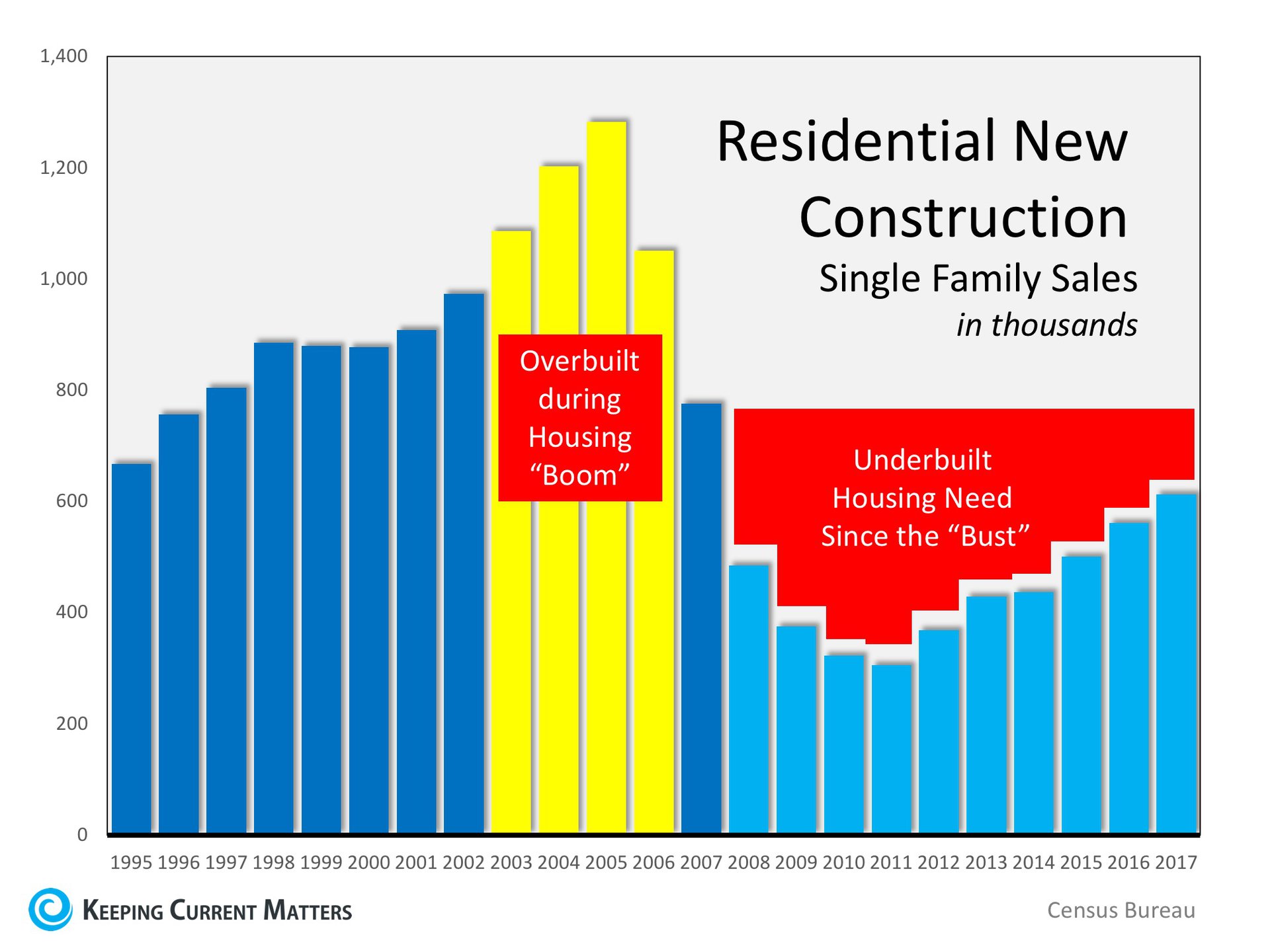
You only need to look at the graph below to understand:

Why are Existing Home Sales Down? | Keeping Current Matters

New construction sales over the last ten years are far below historic numbers from 1995-2002.

A recent industry report looked at building permits and concluded:

“If construction over the past decade matched historic norms, accounting for population change, the country would have had 2.3 million more single-family home permits.”

That decade of not building enough homes is the primary reason for the concerns about today’s market.

Wait, weren’t we talking about ‘existing’ home sales?

Some may argue that NAR’s sales report deals with existing home sales and not new construction, and they would be correct. However, reports have shown that one of the main reasons why existing homeowners are not selling is because they can’t find homes that meet the needs of their current lifestyles. Historically, the upgrades in a newly constructed home were the answers to those needs.

Over the last decade, however, there were fewer homes built to satisfy this move-up seller. Consequently, there are many homeowners who stayed in their homes for a longer tenure, instead of putting their homes up for sale.

Bottom Line

As more new homes are being built, there will be more housing inventory to satisfy current demand which will cause prices to moderate and sales volumes to increase.

Aug. 30, 2018

Top 3 Myths About Today's Real Estate Market?

Top 3 Myths About Today’s Real Estate Market | Keeping Current Matters

There are many conflicting headlines when it comes to describing today’s real estate market. Some are making comparisons to the market we experienced 10 years ago and are starting to believe that we may be doomed to repeat ourselves. Others are just plain wrong when it comes to what it takes to qualify for a mortgage.

Today, we want to try and clear the air by shedding some light on what’s causing some of these headlines, as well as what’s truly going on.

Myth #1: We Are Headed for Another Housing Bubble

Home prices have appreciated year-over-year for the last 76 straight months. Many areas of the country are at or near their peak prices achieved before the last housing bubble burst. This has many worried that we are headed towards another housing bubble.

Reality: The biggest challenge facing today’s real estate market is a lack of homes for sale! Demand is strong, as many renters have come off the fence and are searching for their dream homes.

Historically, a normal market requires a 6-month supply of inventory in order for prices to rise with the rate of inflation. According to the National Association of Realtors (NAR) there is currently a 4.3-month supply of inventory.

The US housing market hasn’t had 6-months inventory since August 2012! The concept of supply and demand is what is driving home prices up!

Myth #2: The Rumored Recession Will Lead to Another Housing Market Crash

Economists and analysts know that the country has experienced economic growth for almost a decade. When this happens, they also know that a recession can’t be too far off. But what is a recession?

Merriam-Webster defines a recession as “a period of temporary economic decline during which trade and industrial activity are reduced, generally identified by a fall in GDP in two consecutive quarters.”

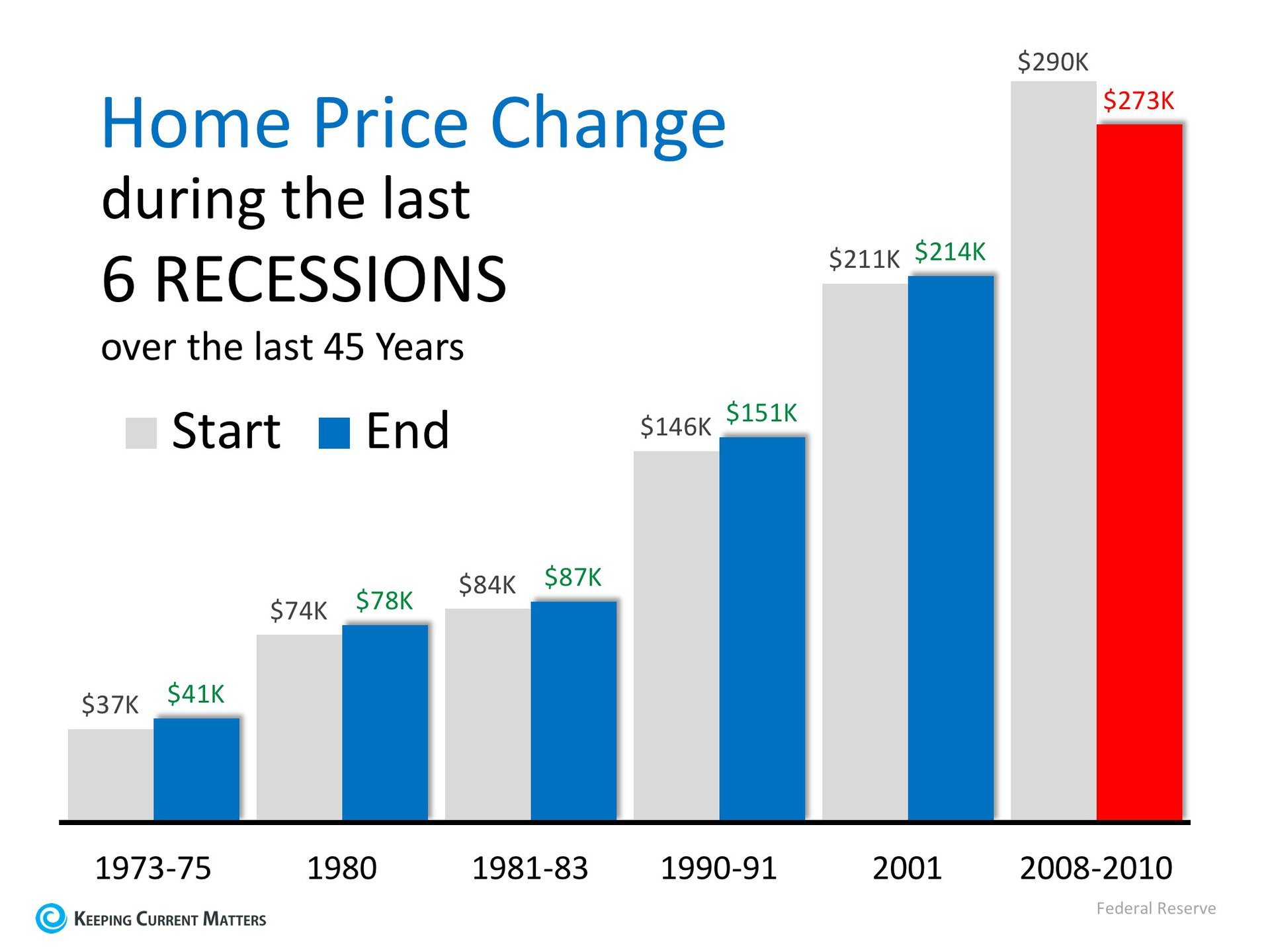
Reality: Recession DOES NOT equal housing crisis. Many people associate these two terms with one another because the last time we had a recession it was caused by a housing crisis. According to the Federal Reserve, over the last 40 years, there have been six recessions. In each of the previous five recessions, home values appreciated.

Myth #3: There is an Affordability Crisis Looming

Rising home prices have many concerned that the average family will no longer be able to afford the most precious piece of the American Dream – their own home.

There are many different affordability indexes supported by different organizations that all measure different data. For this reason, there is a lot of confusion about what “affordable” actually means.

The monthly cost of a home is determined by the home’s price and the interest rate on the mortgage used to purchase it. According to Freddie Mac, interest rates have risen from 3.95% in January to 4.59% just last week.

Reality: As we mentioned earlier, home prices have appreciated year-over-year for the last 76 months, largely driven by high demand and low supply.

According to a recent study by Zillow, the percentage of median income necessary to buy a home in today’s market (17.1%) is well below the mark reached in 1985 – 2000 (21%), as well as the mark reached in 2006 (25.4)! Interest rates would have to increase to 6% before buying a home would be less affordable than historical norms.

The starter-home market has appreciated at higher levels (9.4% year-over-year) than any other market. One reason for this is the fact that many of the first-time buyers who have flocked to the starter-home market are being met with high competition. For some hopeful buyers, it may take more than a good offer to stand out from the crowd!

Bottom Line

There is a lot of confusion in today’s real estate market. If your future plans include buying or selling, make sure you have a trusted advisor and market expert by your side to help guide you to the best decision for you and your family.

Aug. 20, 2018

Are You Thinking of Selling Your Home? Competition Is Coming!?

Are You Thinking of Selling Your Home? Competition Is Coming! | Keeping Current Matters

The number of building permits issued for single-family homes is the best indicator of how many newly built homes will rise over the next few months. According to the latest U.S. Census Bureau and U.S. Department of Housing & Urban Development Residential Sales Report, the number of building permits issued in June was 850,000, a 0.8% increase from May.

How will this impact buyers?

More inventory means more options. Mark Fleming, First American’s Chief Economist, explained that this is good news for the housing market – especially for those looking to buy:

“The continued year-over-year growth in completions means more homes on the market in the short-term, offering some immediate relief in alleviating housing supply shortages.”

How will this impact sellers?

More inventory means more competition. Today, because of the tremendous lack of inventory, a seller can expect:

  1. A great price on their home as buyers outbid each other for it.
  2. A quick sale as buyers have such little inventory to choose from.
  3. Fewer hassles as buyers don’t want to “rock the boat” on the deal.

Bottom Line

If you are considering selling your house, you’ll want to beat this new competition to market to ensure that you get the most attention on your listing and the best price for your house.

Posted in Selling Your Home
Aug. 12, 2018

5 Reasons to Hire a Real Estate Professional Before Entering the Market!?

5 Reasons to Hire a Real Estate Professional Before Entering the Market! | Keeping Current Matters

Whether you are buying or selling a home, it can be quite the adventure. In this world of instant gratification and internet searches, many sellers think that they can ‘For Sale by Owner’ or ‘FSBO,’ but it’s not as easy as it may seem. That’s why you need an experienced real estate professional to guide you on the path to achieving your ultimate goal!

The 5 reasons you need a real estate professional in your corner haven’t changed but have rather been strengthened by the projections of higher mortgage interest rates and home prices as the market continues to pick up steam.

1. What do you do with all this paperwork?

Each state has different regulations regarding the contracts required for a successful sale, and these regulations are constantly changing. A true real estate professional is an expert in his or her market and can guide you through the stacks of paperwork necessary to make your dream a reality.

2. So you found your dream house, now what?

There are over 230 possible steps that need to take place during every successful real estate transaction. Don’t you want someone who has been there before, someone who knows what these actions are, to ensure you achieve your dream?

3. Are you a good negotiator?

So maybe you’re not convinced that you need an agent to sell your home. After looking at the list of parties that you will need to be prepared to negotiate with, you’ll soon realize the value in selecting a real estate professional. From the buyers (who want the best deals possible), to the home inspection companies, all the way to the appraisers, there are at least 11 different people who you will need to be knowledgeable of, and answer to, during the process.

4. What is the home you’re buying/selling really worth?

It is important for your home to be priced correctly from the start in order to attract the right buyers and shorten the amount of time that it’s on the market. You need someone who is not emotionally connected to your home to give you its true value. According to a recent article by the National Association of Realtors, FSBOs achieve prices significantly lower than the prices of similar properties sold by real estate agents:

FSBOs earn an average of $60,000 to $90,000 less on the sale of their home than sellers who work with a real estate agent.”

Get the most out of your transaction by hiring a professional!

5. Do you know what’s really going on in the market?

There is so much information out there on the news and on the internet about home sales, prices, and mortgage rates; how do you know what’s going on specifically in your area? Who do you turn to in order to competitively and correctly price your home at the beginning of the selling process? How do you know what to offer on your dream home without paying too much, or offending the seller with a lowball offer?

Dave Ramsey, the financial guru, advises:

“When getting help with money, whether it’s insurance, real estate or investments, you should always look for someone with the heart of a teacher, not the heart of a salesman.”

Hiring an agent who has his or her finger on the pulse of the market will make your buying or selling experience an educated one. You need someone who is going to tell you the truth, not just what they think you want to hear.

Bottom Line

You wouldn’t replace the engine in your car without a trusted mechanic, so why would you make one of the most important financial decisions of your life without hiring a real estate professional?

Posted in Negotiations
Aug. 12, 2018

Home Buying Myths Slayed [INFOGRAPHIC]?

Home Buying Myths Slayed [INFOGRAPHIC] | Keeping Current Matters

Some Highlights:

  • The average down payment for first-time homebuyers is only 6%!
  • Despite mortgage interest rates being over 4%, rates are still below historic numbers.
  • 88% of property managers raised their rents in the last 12 months!
Posted in Buying a home
July 29, 2018

4 Reasons Why We Are Not Heading Toward Another Housing Bubble?

4 Reasons Why We Are Not Heading Toward Another Housing Bubble | Keeping Current Matters

With home prices continuing to appreciate above historic levels, some are concerned that we may be heading for another housing ‘boom & bust.’ It is important to remember, however, that today’s market is quite different than the bubble market of twelve years ago.

Here are four key metrics that will explain why:

    1. Home Prices
    2. Mortgage Standards
    3. Foreclosure Rates
    4. Housing Affordability

1. HOME PRICES

There is no doubt that home prices have reached 2006 levels in many markets across the country. However, after more than a decade, home prices should be much higher based on inflation alone.

Last week, CoreLogic reported that,

“The inflation-adjusted U.S. median sale price in June 2006 was $247,110 (or $199,899 in 2006 dollars), compared with $213,400 in March 2018.” (This is the latest data available.)

2. MORTGAGE STANDARDS

Many are concerned that lending institutions are again easing standards to a level that helped create the last housing bubble. However, there is proof that today’s standards are nowhere near as lenient as they were leading up to the crash.

The Urban Institute’s Housing Finance Policy Center issues a monthly index which,

“…measures the percentage of home purchase loans that are likely to default—that is, go unpaid for more than 90 days past their due date. A lower HCAI indicates that lenders are unwilling to tolerate defaults and are imposing tighter lending standards, making it harder to get a loan. A higher HCAI indicates that lenders are willing to tolerate defaults and are taking more risks, making it easier to get a loan.”

Their July Housing Credit Availability Index revealed:

“Significant space remains to safely expand the credit box. If the current default risk was doubled across all channels, risk would still be well within the pre-crisis standard of 12.5 percent from 2001 to 2003 for the whole mortgage market.”

3. FORECLOSURE RATES

A major cause of the housing crash last decade was the number of foreclosures that hit the market. They not only increased the supply of homes for sale but were also being sold at 20-50% discounts. Foreclosures helped drive down all home values.

Today, foreclosure numbers are lower than they were before the housing boom. Here are the number of consumers with new foreclosures according to the Federal Reserve’s most recent Household Debt and Credit Report:

  • 2003: 203,320 (earliest reported numbers)
  • 2009: 566,180 (at the valley of the crash)
  • Today: 76,480

Foreclosures today are less than 40% of what they were in 2003.

4. HOUSING AFFORDABILITY

Contrary to many headlines, home affordability is better now than it was prior to the last housing boom. In the same article referenced in #1, CoreLogic revealed that in the vast majority of markets, “the inflation-adjusted, principal-and-interest mortgage payments that homebuyers have committed to this year remain much lower than their pre-crisis peaks.”

They went on to explain:

“The main reason the typical mortgage payment remains well below record levels in most of the country is that the average mortgage rate back in June 2006, when the U.S. typical mortgage payment peaked, was about 6.7 percent, compared with an average mortgage rate of about 4.4 percent in March 2018.”

The “price” of a home may be higher, but the “cost” is still below historic norms.

Bottom Line

After using these four key housing metrics to compare today to last decade, we can see that the current market is not anything like that bubble market.

July 29, 2018

Housing Will Not Fall Victim to Next Economic Storm?

Housing Will Not Fall Victim to Next Economic Storm | Keeping Current Matters

Some experts are calling for a slowdown in the economy later this year and most economists have predicted that the next recession could only be eighteen months away. The question is, what impact will a recession have on the housing market?

Here are the opinions of several experts on the subject:

Ivy Zelman in her latest “Z Report”:

“While economic activity appears to have accelerated so far in 2018, some prominent economic forecasters have become more cautious about growth prospects for 2019 and 2020…

All told, while solid long-term demographic underpinnings support our positive fundamental outlook for housing, in the event micro-economic headwinds surface, we would expect housing transaction volumes and home prices to weather the storm.”

Aaron Terrazas, Zillow’s Senior Economist:

“While much remains unknown about the precise path of the U.S. economy in the years ahead, another housing market crisis is unlikely to be a central protagonist in the next nationwide downturn.”

Mark Fleming, First American’s Chief Economist:

“If a recession is to occur, it is unlikely to be caused by housing-related activity, and therefore the housing sector should be one of the leading sources to come out of the recession.”

Mark J. Hulbert, Financial Analyst and Journalist:

“Real estate may be one of your best investments during the next bear market for stocks. And by real estate, I mean your home or other residential properties.”

U.S. News and World Report:

“Fortunately – and hopefully – the history of recessions and current issues that could harm the economy don’t lead many to believe the housing market crash will repeat itself in an upcoming decline.”

July 8, 2018

Next Recession in 2020? What Will Be the Impact?

Next Recession in 2020? What Will Be the Impact? | Keeping Current Matters

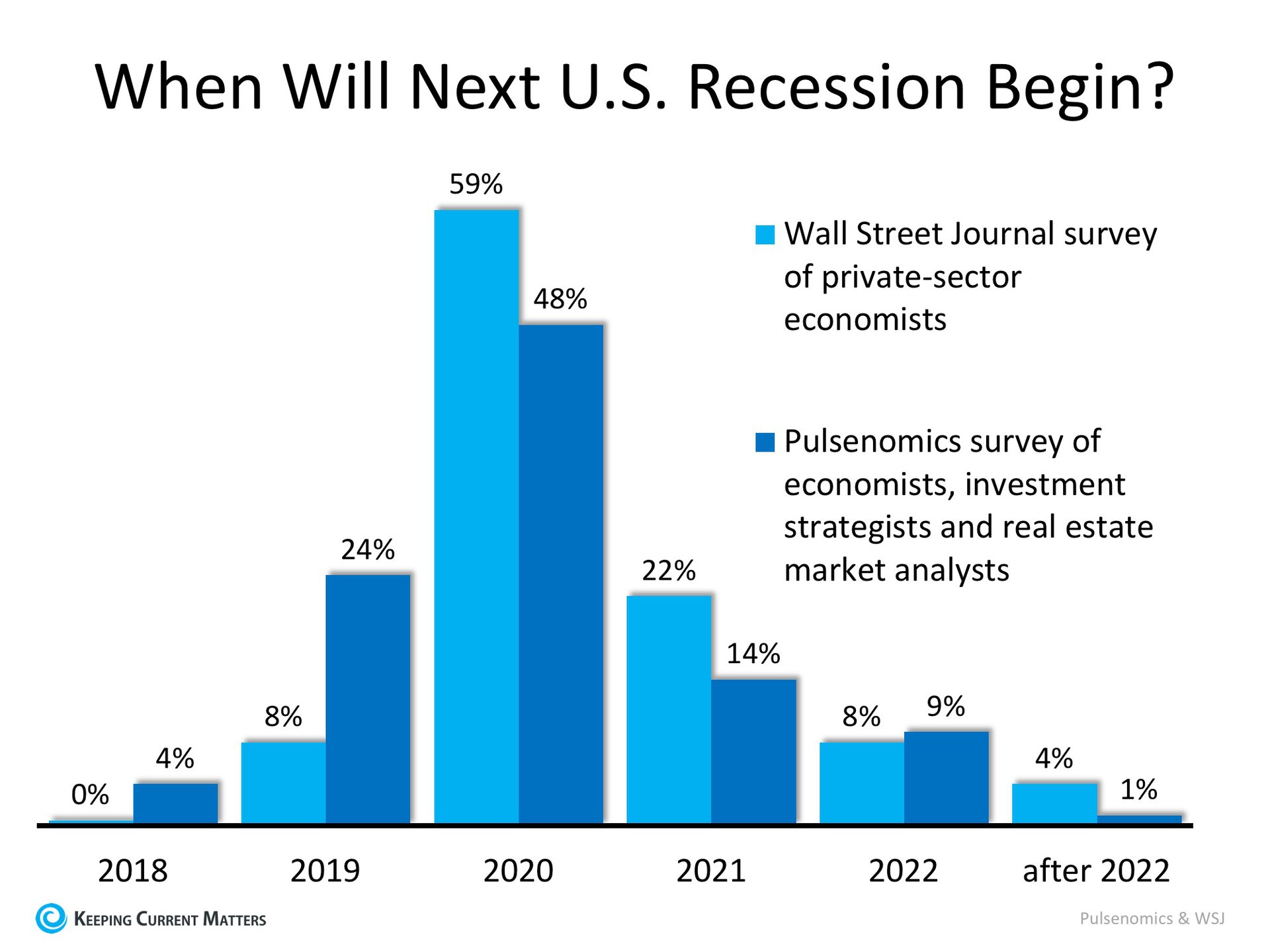
Economists and analysts know that the country has experienced economic growth for almost a decade. They also know that a recession can’t be too far off. A recent report by Zillow Research shed light on a survey conducted by Pulsenomics in which they asked economists, investment strategists and market analysts how they felt about the current housing market. That report revealed the possible timing of the next recession:

Experts largely expect the next recession to begin in 2020.”

That timing concurs with a recent survey of economists by the Wall Street Journal:

“The economic expansion that began in mid-2009 and already ranks as the second-longest in American history most likely will end in 2020 as the Federal Reserve raises interest rates to cool off an overheating economy, according to forecasters surveyed.”

Here is a graph comparing the opinions of those surveyed by both the Wall Street Journal and Pulsenomics:

Next Recession in 2020? What Will Be the Impact? | Keeping Current Matters

Recession DOES NOT Equal Housing Crisis

According to the Merriam-Webster Dictionary, a recession is defined as follows:

“A period of temporary economic decline during which trade and industrial activity are reduced, generally identified by a fall in GDP in two successive quarters.”

A recession means the economy has slowed down markedly. It does not mean we are experiencing another housing crisis. Obviously, the housing crash of 2008 caused the last recession. However, during the previous five recessions home values appreciated.

Next Recession in 2020? What Will Be the Impact? | Keeping Current Matters

According to the experts surveyed by Pulsenomics, the top three probable triggers for the next recession are:

  • Monetary policy
  • Trade policy
  • A stock market correction

A housing market correction was ranked ninth in probability. Those same experts also projected that home values would continue to appreciate in 2019, 2020, 2021 and 2022.  

Others agree that housing will not be impacted like it was a decade ago.

Mark Fleming, First American’s Chief Economistexplained:

“If a recession is to occur, it is unlikely to be caused by housing-related activity, and therefore the housing sector should be one of the leading sources to come out of the recession.”

And U.S. News and World Report agreed:

“Fortunately – and hopefully – the history of recessions and current issues that could harm the economy don’t lead many to believe the housing market crash will repeat itself in an upcoming decline.”

Bottom Line

A recession is probably less than two years away. A housing crisis is not.