Real Talk 

When it comes to making a great real estate investment, knowledge is key. Our blog provides the essential information you'll need to make your next move.

April 19, 2016

If You Are Thinking Of Selling, Now Is The Time


If You Are Thinking of Selling, Now Is The Time


If You Are Thinking of Selling, Now Is The Time | Keeping Current Matters

If you thought about selling your house this year, now may be the time to do it. The inventory of homes for sale is well below historic norms and buyer demand is skyrocketing. We were still in high school when we learned the concept of supply and demand: the best time to sell something is when supply of that item is low and demand for that item is high. That defines today’s real estate market.

Jonathan Smoke, the Chief Economist of realtor.com, in a recent article revealed that:

“Would-be buyers face a dilemma: There will be more homes on the market over each week of the next three to four months, but there will also be even more prospective buyers. We are entering the busiest season of home buying with the lowest amount of inventory in three years. To be competitive, buyers should get pre-approved for a mortgage and be ready to act quickly if they find a home that meets their needs.”

Smoke goes on to say:

“Listings are growing as they normally do this time of the year, but because demand has been growing faster than supply, homes are selling faster. So the monthly trend is the normal seasonal pattern, but the year-over-year decline is reflective of demand being stronger than supply for more than a year, which is resulting in fewer homes available and faster-moving inventory.”

In this type of market, a seller may hold a major negotiating advantage when it comes to price and other aspects of the real estate transaction including the inspection, appraisal and financing contingencies.

Bottom Line

As a potential seller, you are in the driver’s seat right now. It might be time to hit the gas.

Posted in Selling Your Home
April 16, 2016

Private Mortgage Insurance

Private Mortgage Insurance

pmi

 Buying a home with a down payment of less than 20 percent can be expensive, but it just got cheaper for some home buyers. Many private mortgage insurers have dropped the rates they charge high quality borrower. Combined with historically low mortgage rates, this change could unlock ownership and improve affordability for many borrowers.

The Cost of Insurance

While most people focus on mortgage rates, mortgage insurance can add significantly to the cost of borrowing. Fannie Mae and Freddie Mac (the GSEs) require borrowers who puts down less than 20 percent to pay for private mortgage insurance (PMI). The GSEs also charge separate fees called loan level pricing adjustments (LLPAs) for particular borrowers including those who put down less than 20 percent. These two fees, PMI and LLPAs, constitute insurance that low down payment borrowers are charged for conventional loans. Likewise, mortgages backed by the Federal Housing Administration (FHA) are charged a mortgage insurance premium. These mortgage insurance fees can add significant costs to the monthly payment for a home.

Why Are the Fees Changing?

Fannie Mae and Freddie Mac buy loans from lenders, package them into mortgage back securities (MBS), and then sell the MBS to investors with a guarantee that if anything bad happens, the buyer of the MBS will still get their money. This guarantee makes the GSEs insurers against anything that might go wrong including losses on loans greater than what the private mortgage insurers cover or if the private mortgage insurer goes out of business.

During the recent crisis, most insurers took significant losses as loans went bad. Absorbing losses is the insurers’ job, though. Insurers charge fees and use these fees as capital to pay claims as loans go bad. Some insurers did not hold enough capital and subsequently went out of business. When those claims went unpaid or insurers went out of business, those losses had to be paid by the GSEs. To prevent losses like this in the future, the GSEs set up new rules requiring best practices as well as higher amounts of capital of the private insurers with whom they do business.

Furthermore, the GSEs specified that the private mortgage insurers must hold specific amounts of capital against borrowers with particular characteristics. This type of system is called risk-based pricing where riskier borrowers, those with lower credit scores or smaller down payments or other characteristics, pay more. Historically, the GSEs used pooled or average-cost pricing where all borrowers paid the same fee, which reflected the average borrower’s risk.

Who Benefits and Who Loses?

Borrowers with a down payment greater than 10 percent or a credit score greater than 739 will benefit the most from the recent changes. However, borrowers with credit scores under 700 and down payments less than 10 percent will pay more. As depicted below, a borrower with a 760 credit score and a 3 percent down payment will pay $83 less each month, while a borrower with a 630 credit score would pay $128 more.

monthly payment

The FHA made headlines in 2015 after reducing its annual mortgage insurance premium from 1.35 percent to 0.85 percent. This change drew many new borrowers into the market but also attracted some higher quality borrowers from the GSEs. As depicted below, the recent reduction in private mortgage insurance premiums will make GSE-backed loans cheaper for those with the highest credit scores. This change will draw some of the best qualified borrowers back to the GSEs from the FHA. Borrowers facing PMI increases will likely remain with the FHA. Some borrowers might pay more for PMI than FHA insurance but will switch to the GSEs because private mortgage insurance is extinguished when the loan-to-value rate reaches 78 percent, while the FHA’s insurance must be paid for the life of the loan.

conventional

Market Impact

A steady, stable flow of affordable credit is important for the housing market. The cost of both private and government supported insurance programs has improved since 2014, while still providing sufficient capital to maintain long-term soundness of insurers.

The increases in PMI fees for weaker borrowers will reinforce the FHA’s recent premium cuts retaining these borrowers at the FHA. Reduced fees for stronger borrowers will draw a small share of the FHA’s business to the private sector. As a result, the FHA is likely to remain a significant player in the market for low down payment borrowers. Retaining some of the stronger borrowers is important to keep insurance costs down in the FHA’s average cost model and to reduce any potential impact to tax payers. Thus, in the years to come as lenders reduce overlays on the FHA’s program and weaker borrower re-enter the market, the stronger borrowers in the FHA’s book of business will help to offset the cost of weaker borrowers.

First time buyers as well as buyers in high cost markets will benefit from improved mortgage insurance pricing in 2016. These changes reflect stronger capital rules intended to strengthen the financial health of the market, but they will also help to save consumers money.

Posted in Loan Options
April 13, 2016

Top Reasons Why Americans Buy Homes

The Top Reasons Why American Americans Buy Homes

The Top Reasons Why Americans Buy Homes| Keeping Current Matters

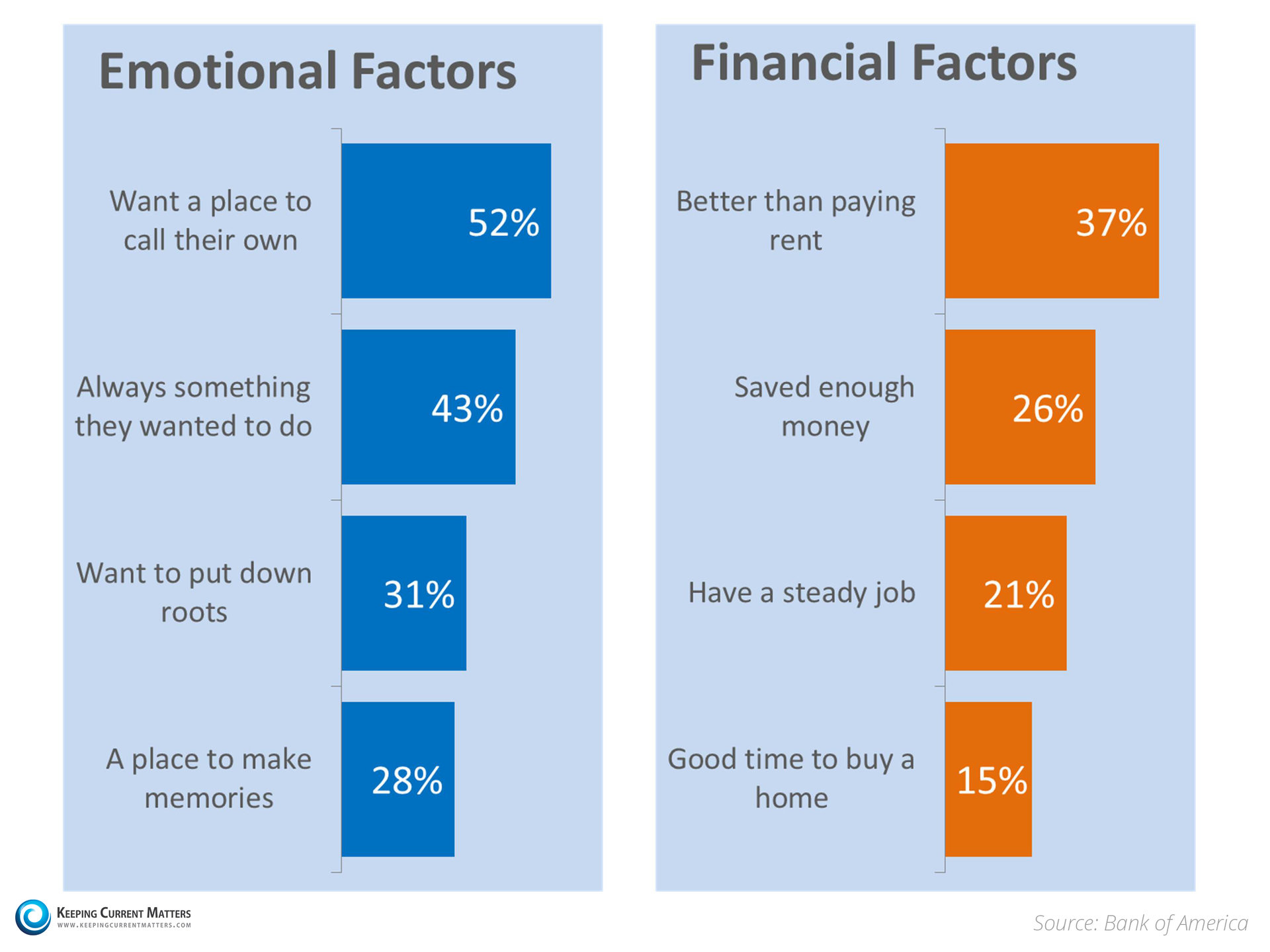
Last week, the inaugural “Homebuyer Insights Report” was released by the Bank of America. The report revealed the reasons why consumers purchase homes and what their feelings are regarding homeownership.

Consumer Lending Executive, D. Steve Boland, explained:

“Homebuyers today are motivated by both emotional and practical reasons. Nearly all want more space, but a majority of homebuyers, especially those purchasing their first home, are also looking for a place to call their own, put down roots and make memories. They value the emotional benefits of owning a home as much as the financial ones.”

The Top Reasons Why Americans Buy Homes| Keeping Current Matters

Boland went on to say:

“The path to homeownership is a journey and can be as overwhelming as it is exciting. For many people, this is the single most significant financial transaction they will ever make.”

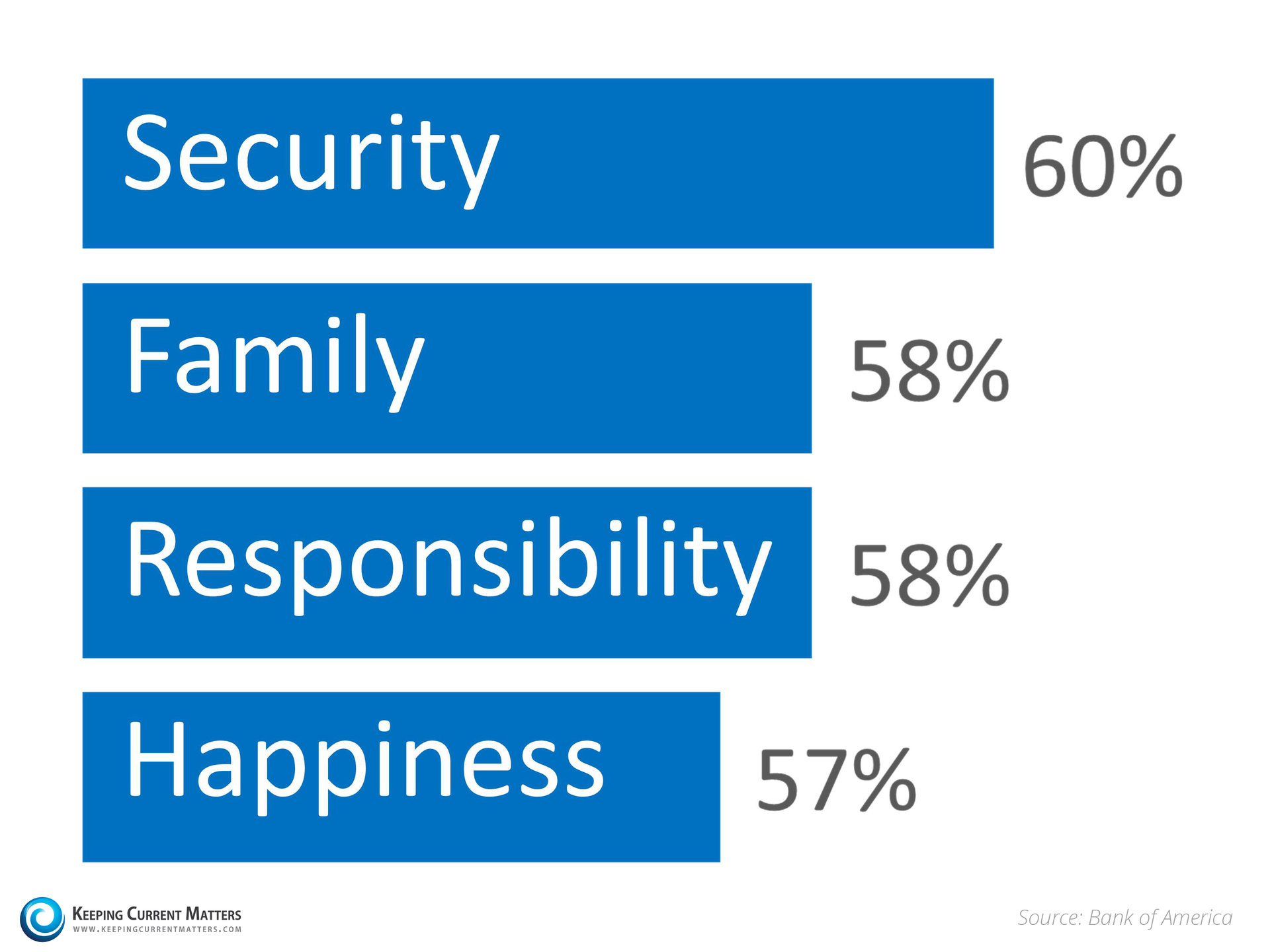
This was evidenced in the report when they asked today’s homebuyers to define homeownership. Their answers tell the whole story.

The Top Reasons Why Americans Buy Homes| Keeping Current Matters

Bottom Line

Homeownership has always been a part of the American Dream and survey after survey confirms this will always be the case.

Posted in Buying a home
April 11, 2016

Real Estate:2016 Will Be The Best Year in a Decade

Real Estate: 2016 Will Be the Best Year in a Decade


Real Estate: 2016 Will Be the Best Year in a Decade | Keeping Current Matters

A few weeks ago, Jonathan Smoke, the Chief Economist at realtor.com, exclaimed: “All indicators point to this spring being the busiest since 2006.”

Now, Freddie Mac has doubled down on that claim and is saying that 2016 will be the best year that the real estate industry has seen in a decade. In their March Housing Outlook Report, Freddie Mac explained:

“Despite the challenges facing the housing market, we expect this to be the best year for housing in a decade. Home sales, housing starts, and house prices will reach their highest level since 2006 according to our latest forecast…Challenges remain, with low housing supply and declining affordability being a key concern in many markets, but on balance, the housing markets in the U.S. are poised for the best year since 2006.”

The key indicators that have given Freddie Mac such a positive outlook are:

  • Low interest rates
  • A resilient labor market
  • An increase in household formations
  • A projected increase in newly constructed homes

Bottom Line

2016 looks to be shaping up as a great year for residential real estate. Whether you are thinking of buying or selling, now may be the time to sit down with a real estate professional to discuss the new opportunities that are arising.

April 7, 2016

Design Trends to Watch for 2016

Design Trends to Watch in 2016

By Melissa Dittmann Tracey, REALTOR® Magazine

What are the hot trends to look out for in 2016 in home design? Here are a few predictions from the remodeling and design site Houzz on some of the big trends to expect.

1. Two shades of kitchen cabinets.
The upper cabinets may be a white or neutral but then more designers are trying out deeper colors or wood tones for the lower cabinets.


2. Formal dining rooms are back.
More home owners are opting to keep the dining room and not turn it into an office. The formal dining room is expected to get more attention this year.

3. Multi-purpose kitchen islands.
The “workhorse” kitchen island is about more than just adding workspace in the kitchen, but also for adding more storage, prep sinks, and a way to add extra seating.


4. Mirrors that make a statement.
Medicine cabinets are heading out and now wood-framed, modern, or vintage mirrors are adding more style to bathrooms.


5. “Barely there” kitchens.
Kitchens are fading into the backdrop as the open layouts infuse more seamlessly into the living room or other spaces in the home. Aiding that trend, more kitchens are featuring open shelves to add to that openness.


6. Sunrooms are hot.
Houzz identified this as one of the top dream spaces for home owners. Some home owners are finding ways to even transform tucked away corners in their home into a sunroom with a few chairs to relax near windows.

7. White kitchens dominate.
White kitchen walls and cabinets and even countertops is a trend with staying power, Houzz predicts. To add some splash to the all-white kitchen, designers are adding touches of color through the tile floors or floor-to-ceiling bookcases.

8. Powder rooms get more bold.
Wall coverings are getting punched up in powder room, that include everything from custom graphics to textured walls. Also, designers are mixing in ornate chandeliers or furniture-like pieces to add some more pizzazz to these spaces.


9. Farmhouse style guides the entryway.
Farmhouse style is catching on, particularly for the mudroom. Simplicity in the storage solutions and durable materials are taking charge.

View the full 25 list of trends to watch in 2016 at Houzz.

April 4, 2016

Why You Should Hire A Professional When Buying A Home

Why You Should Hire A Professional When Buying A Home!

Why You Should Hire A Professional When Buying A Home! | Keeping Current Matters

Many people wonder whether they should hire a real estate professional to assist them in buying their dream home or if they should first try to go it on their own. In today’s market: you need an experienced professional!

You Need an Expert Guide if you are Traveling a Dangerous Path

The field of real estate is loaded with land mines. You need a true expert to guide you through the dangerous pitfalls that currently exist. Finding a home that is priced appropriately and ready for you to move in to can be tricky. An agent listens to your wants and needs, and can sift out the homes that do not fit within the parameters of your “dream home”.

A great agent will also have relationships with mortgage professionals and other experts that you will need in securing your dream home.

You Need a Skilled Negotiator

In today’s market, hiring a talented negotiator could save you thousands, perhaps tens of thousands of dollars. Each step of the way – from the original offer, to the possible renegotiation of that offer after a home inspection, to the possible cancellation of the deal based on a troubled appraisal – you need someone who can keep the deal together until it closes.

Realize that when an agent is negotiating their commission with you, they are negotiating their own salary; the salary that keeps a roof over their family’s head; the salary that puts food on their family’s table. If they are quick to take less when negotiating for themselves and their families, what makes you think they will not act the same way when negotiating for you and your family?

If they were Clark Kent when negotiating with you, they will not turn into Superman when negotiating with the buyer or seller in your deal.

Bottom Line

Famous sayings become famous because they are true. You get what you pay for. Just like a good accountant or a good attorney, a good agent will save you money…not cost you money.

Posted in Buying a home
March 25, 2016

Further Proof This Isn’t a Housing Bubble

Further Proof This Isn’t a Housing Bubble | Keeping Current Matters

Two weeks ago, we posted a blog which explained that current increases in home prices were the result of the well-known concept of supply & demand and should not lead to conversations of a new housing bubble. Today, we want to look at home prices as compared to current incomes.

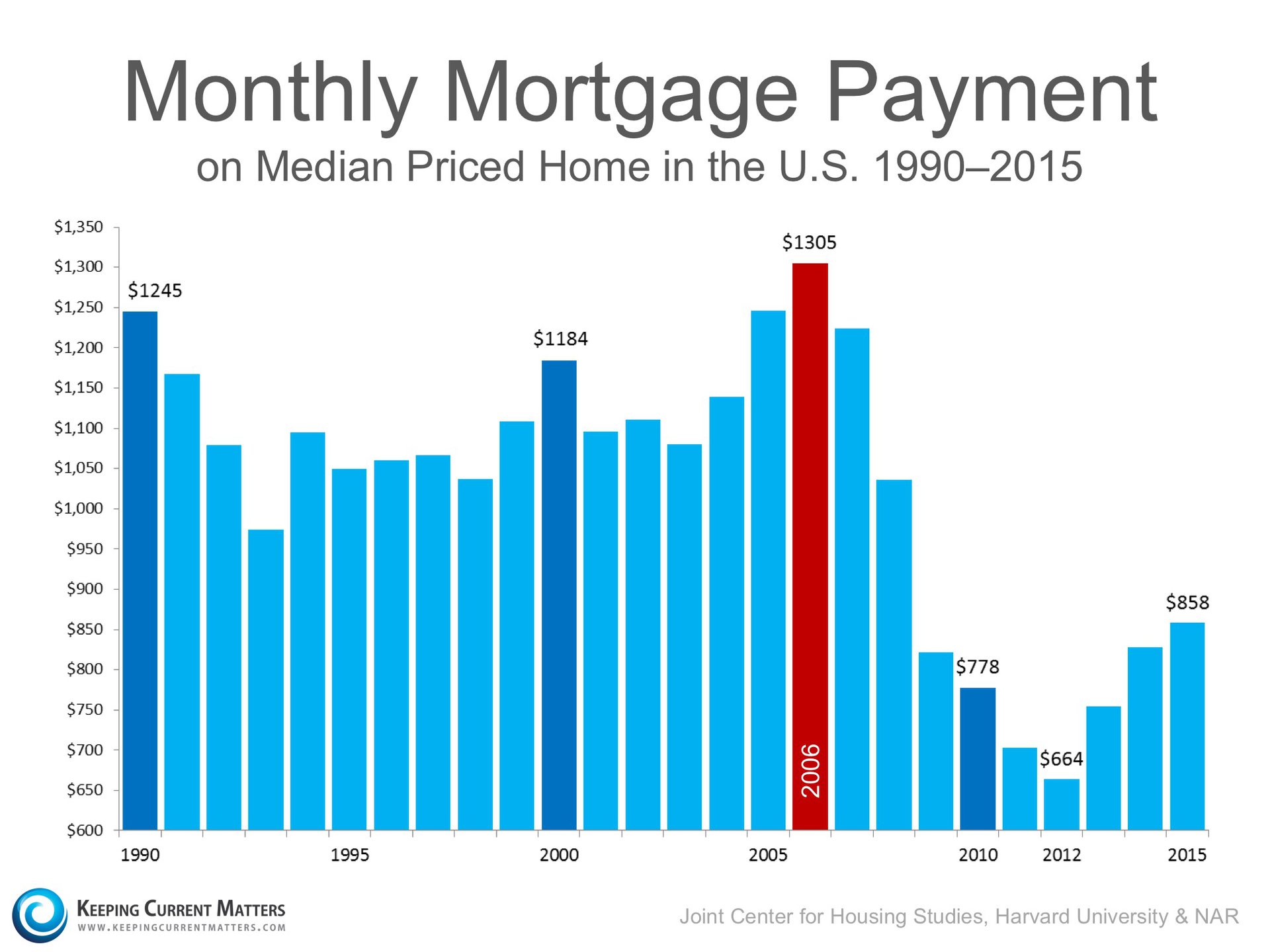
Here is a graph showing the monthly mortgage payment on a median priced home in the U.S. over the last 25 years:

Further Proof This Isn’t a Housing Bubble | Keeping Current Matters

Mortgage payments are currently well below the historic average over that time period. Purchasers are not overextending themselves to buy a home like they did on the run-up to the housing crash.

Lawrence Yun, the Chief Economist at the National Association of Realtors, recently explained in a Forbes article:

“Even though home prices are climbing far above people’s income, exceptionally low mortgage rates have permitted people to buy a home without overstretching their budget. For someone making a 20% down payment, the monthly mortgage payment at today’s mortgage rates would take up 15% of a person’s gross income. During the bubble years, it was reaching 25% of income. The long-term historical average is around 20%. Therefore, a middle-income household does not need to overstretch their budget much if at all to buy a typical home.”

Bottom Line

Due to low interest rates, demand for housing has dramatically increased. This has caused a jump in home prices. However, low interest rates have also allowed the monthly cost of buying a home to remain well below historic norms. We are in a strong housing market, not a housing bubble.

March 16, 2016

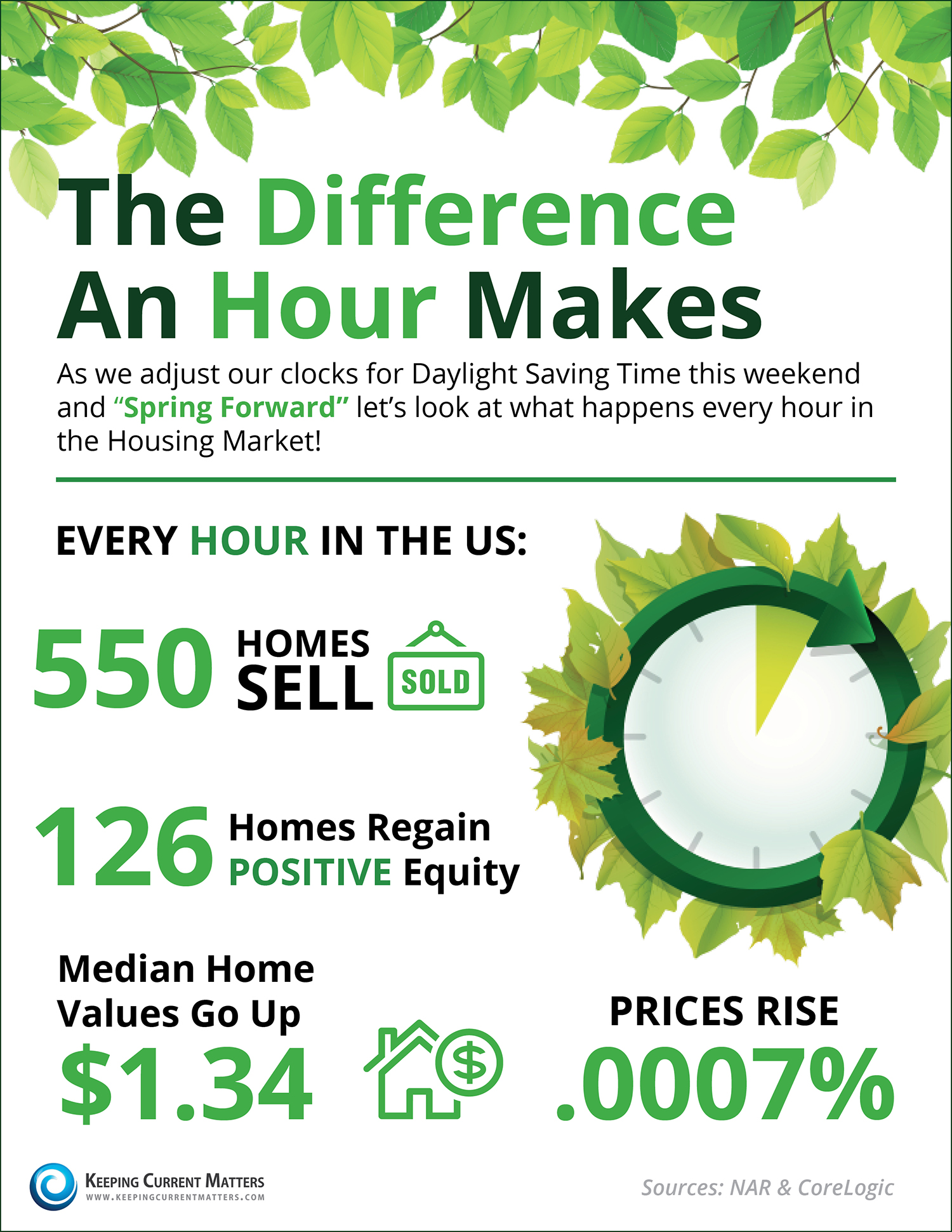
The difference an hour makes

Posted in Selling Your Home
Feb. 22, 2016

Biggest Home Seller Mistakes

Data provided by ActiveRain.com. ActiveRain is an online community of real estate professionals who exchange best practices, write real estate blogs, and get free education from the industry and their peers.

Here are the top mistakes real estate agents commonly see made by homeowners looking to sell their house.

1. Overpriced Home

Nothing shocking here. This was far and away the most common mistake sellers make that prevent them from selling their home. 

If you overprice your home there is a pretty good chance no one is going to want to buy it. Real estate agents do not set the real estate market. A great real estate agent will suggest a price at which to list your home based on comparable homes that have already sold in the market. Overpricing a home to 'see if you can get someone to bite' is not a strategy employed by someone really serious about selling. Overpricing a home will lead to missed opportunities with buyers that are serious about buying in the range at which your home should be listed.

The first week during which a home is listed will generally be the time that the most eyeballs are on the home and the largest potential pool of buyers will be exposed to the listing. Setting a price that reflects the market is essential to selling! This is exacerbated in a downward trending market. Many a seller has lost thousands, even tens of thousands of dollars chasing a market down after setting a listing price that was outside what the market was willing to bear.

Margaret Goss, a Broker with Baird & Warner on the North Side of Chicago gives you a few reasons that an agent will take your overpriced listing and then shares the repercussions of making the decision to price your home too high. 

2. Showing Availability - It's Difficult to Set a Showing

The chances your home will sell when buyers can't get in to physically inspect the property are minuscule. Sellers need to understand that listing a home for sale is going to lead to some inconveniences in your normal routine. Many serious buyers may want to physically inspect a property during times which may not be convenient for the seller. Knowing this, motivated sellers need to understand that flexibility in when you allow the home to be sold could have a direct impact on the sale of your home.

It's not uncommon for sellers to see 8, 10, even 20 homes during a showing tour with their agent. If your house isn't on that list because you only do showings on Saturday and Sunday from 10am to 4pm, you will miss out on ready, willing and able buyers. 

As a seller, realize that the more people that can see the home in person, the more chance you have to find the buyer that wants your home. Eric Kodner, a broker with Madeline Island Realty in La Pointe Wisconsin shares a real life example of an unavailable seller costing herself a sale and a lot of money.

3. Cluttered Space - Unwilling to Depersonalize or Remove Clutter

Sellers are sometimes unwilling to either make the effort, or unwilling to compromise how they live in their home during the time the home is on the market for showings. Serious sellers realize that by depersonalizing the home and removing unwarranted clutter, it allows potential buyers to more easily visualize their own things in the house.

When you live in your home day in and day out, you become comfortable with your own 'things'. In many cases, however, your 'stuff' can make a room feel smaller than it actually is and in some more extreme cases, your 'stuff' can completely distract someone from visualizing the potential of a room. We know you are proud of your kids as the shrine in the living room displays all of their ribbons, trophies and diplomas from the last 20 years. But for a buyer, this is only a distraction. 

Many agents will make recommendations about ways to remove clutter or depersonalize your home. Some will even suggest that a professional homestager be brought it to completely maximize the space and create a setting maximizes the buyers ability to visualize their own things. The key thing to remember here is these suggestions are not personal and you may have to be a little uncomfortable so that your house puts it's best foot forward.

Ralph Gorgoglione, a real estate agent with the John Aaroe Group in Los Angeles reminds us that "as a seller, the most important thing to realize is that, yes, your crapola means a lot to you. But it means nothing to anyone else." Especially a buyer trying to visualize their own stuff in your house.
 

4. Unpleasant Odors in the House

"Mr and Mrs. Seller, your house stinks!"

Most agents aren't going to be this blunt. But in some cases they wish they could be. They'll take a more tactical approach and say something like.....'during the time your house is on the market, it might be a good idea to smoke outside'.

But what they know is that nothing will stop a potential buyer in their tracks faster than a strong odor of any sort. In some cases this could just be the left over smell from last nights dinner. In more extreme cases, agents tell horror stories of entering homes that have a bad smell of pet urine or smoking. 

The main concern for the buyer is, of course, "is the house going to smell like this once we move in?" Real Estate agents confirm that many a buyer has passed on a home after coming to their own conclusion on that answer. 

Your agent isn't suggesting a fresh coat of paint and new carpet because they don't like how things look. They are making this suggestion because they realize that the smoke odor in your home is going to be a major turn off for anyone thinking about buying your home.

Real estate broker Dick Greenburg with Elevations Real Estate, LLC in Fort Collins Colorado even goes so far as to suggest "homes with bad odors don't sell because buyers are having intense and complex negative reactions that are beyond working around."

5. Seller Unwilling to Make Repairs Prior to Listing

No seller wants to spend a few thousand dollars making repairs to a house you are about to sell. Agents understand that. But they also understand that few buyers want to move in to a house that needs a bunch of work done immediately upon moving in. 

One of your objectives to selling your home is to make it as appealing as possible to as wide of an audience as possible. If the seller is unwilling to make repairs, and a buyer doesn't want a bunch of work upon moving in, you've shrunk the pool of potential buyers for your property.

Some sellers may want to offer the buyer a credit at closing for certain repairs. Real estate broker Chris Ann Cleland, with Long and Foster in Gainesville, VA shares with us why that strategy isn't better thanmaking the repairs yourself before putting the home on the market.
 

6. Sellers Unwilling to Negotiate with Buyers

Setting a market price on a home is not an exact science. Many real estate agents will give the seller a range in which they predict the home will sell. As a seller, you should always want the most money the market will bear. That being said, the unwillingness to negotiate with buyers can turn away even the most serious buyers.

Price is not the only condition which is open to negotiation. Buyers and sellers can negotiate on dates, fixtures that might stay with the home, repairs and a host of other sticking points. Sellers that refuse to negotiate and are set on digging in their heels are much less likely to find a willing and able buyer.

Don't be insulted by low offers. Buyers want to get the home for the best price and on the best terms they can. Just like a sellers wants to sell for the best price on the best terms. It's rare that either party walks away from a negotiation with everything they want. Motivated sellers understand this and are willing to negotiate.

Debbie Reynolds, a broker with Prudential PenFed Realty in Clarksville Tennessee, cautions sellers against being unwilling to negotiate as well as second guessing your original listing price

7. Bad Photos in the MLS

This one will most likely fall on your real estate agent. But knowing that bad photos in the MLS can be an impediment to the sale of your home, as a seller it's imperative that you demand great photography from your agent.

Studies show that greater than 85% of people are going online as a part of their research for buying a home. Most buyers will probably first be introduced to your home online. Poor photos could be cause for them to disregard your home before they ever set foot in it. 

The photos used to market your home are generally the first impression any buyer will have of your home. When picking an agent to list your home, ask to see examples of photos from previous listings. Do their photos make you want to take a look at the home?

Never let your home go on the market without photos! If it means waiting a day or two before listing, wait. A large number of potential buyers in your market will be exposed to your home the first day it goes on the market. Having great photos the first day the home hits the market is a must.

Tammie White, a REALTOR® with Benchmark Realty LLC in Franklin Tennessee tells us why "it is crucial to have professional photographs to show off your home."

8. The Home is Just Plain Messy

You were late for work this morning so you ran out of the house without picking up from last night's dinner. Not a big deal.....unless you have potential buyers that will be stopping by. 

Some people may be able to look past the dishes stacked up in the sink, but enough buyers won't be able to look past the mess. Remember, buyers want to envision their things in your house. The more obstacles you put in the way, the harder time they have connecting with the home emotionally.

Take the time every day to make sure everything is cleaned up and the home is in showing condition. 

Woody Edwards, a REALTOR® with First Choice Realty in Chesterfield Virginia is reminded of an old saying his grandmother used to have, "never leave home until the home is in dying condition". This couldn't be more true than when selling your home. 

9. Sellers Who Like to Play Tour Guide During Showings

Almost every real estate agent who participated agreed that sellers should leave the house during showings. Some sellers want to stick around and make sure buyers see all the important features of a home. The problem with that.........as a seller you don't know what's important to a buyer. 

Sellers that hover around during a showing will make the buyer nervous. They won't feel comfortable discussing things they like or dislike about the house with their agent. In addition, most buyers like to explore a little bit. Interested buyers tend to do things like open cabinets and check in closets to get a better sense for the entire home. A hovering seller can make this very uncomfortable for some buyers.

Bottom line......leave the house when it's being shown. Your presence there will only make things worse. Karen Feltman, a real estate agent with Skogman Realty in Cedar Rapids Iowa gives you a couple ofspecific ways that a seller's meddling during showings can hurt or kill a deal

10. Picking the Wrong Agent

You decided to list with your aunt or with your friend that just got in the business. You paid no attention to their experience or what they do to market a home. Maybe not the best idea. 

Real Estate agents will often suggest interviewing more than one agent. You'll never know if your aunt is going to do a good job of marketing your home for sale if you have nothing to which to compare her. 

Posted in Selling Your Home
Feb. 10, 2016

Debt to Income

4 Strategies to Improve Your Debt-To-Income Ratio and Qualify for a Mortgage

You obviously need a steady job and sufficient income to support a monthly mortgage payment, but the mortgage lender will also evaluate your debt before approving your application. And unfortunately, too much consumer debt can bring your loan to a screeching halt.

Debt-to-income ratio refers to the percentage of monthly income that’s used to pay debt. When applying for a mortgage loan, lenders look at an applicant’s front-end ratio and back-end ratio. The front-end ratio, also called the housing ratio, is the percentage of your gross monthly income used to pay the mortgage. The back-end ratio is the percentage of total minimum debt payments (including the mortgage payment) in relation to gross income.

You might think your debt isn’t a big deal, especially if you pay on time. What you may fail to realize is that too much debt can ruin your chances of qualifying for a mortgage. Lenders don’t expect applicants to have zero debt. But they do expect a reasonable level of debt.

Typically, your front-end ratio should be no more than 28% to 31% of gross monthly income, depending on the type of mortgage. Total debt payments, or the back-end ratio, should not exceed 43%. Some people apply for a mortgage with confidence, so being rejected because of debt often comes as a chock. From a lender’s standpoint, excessive debt strains an applicant’s budget. And when applicants are overextended, there's a higher risk of default.

Being rejected for a mortgage can put a black cloud over your day, week or month, but a high debt-to-income ratio is fixable. Here are some of the best strategies for improving your ratio and qualifying for a mortgage.

1. Pay off credit cards and loan balances

If your mortgage lender won’t approve a loan because of debt, paying off credit cards and loans is one of the quickest ways to get your application approved.

Sometimes, applicants are rejected because their debt-to-income ratio is slightly over the percentage allowed by the lender. Paying off credit cards or loan balances can free up cash in your budget, which can help you qualify. Just make sure you check with the lender first. While paying off debt can improve your debt ratio, it can also drain your cash reserve, and you may not have enough money for your down payment, closing costs and other mortgage-related expenses.

2. Apply with a joint applicant

Some heads of households apply for a mortgage in their name only. But if there’s too much debt, the lender may reject his application until he pays off balances or increases his income.

Since income isn't something we can increase overnight, you might make headway by adding your spouse to the mortgage application, even if he or she only works part-time. The lender will calculate your combined income, which can result in an overall lower debt-to-income ratio— providing your spouse doesn't have too many of his or her own debts.

3. Seek new employment

Changing jobs during the lending process is dangerous, especially since lenders prefer at least 12 months of consistent income. But if you switch jobs and remain in the same field and earn the same salary or more, you shouldn’t have any issues finalizing the loan. Therefore, if you can't qualify for a particular amount because of a higher debt ratio, getting a job that pays considerably more can reduce your ratio and help you qualify.

If your gross annual income is $45,000 or $3,750 a month, based on your existing debt the lender may conclude that the most you can spend on a mortgage payment—including principal, taxes and insurance—is $1,050. Since this limits how much you can spend on a property, you might not qualify for homes with a higher price range. But if you found a new job earning an additional $10,000 a year, the lender may say you qualify for a mortgage with a payment of $1,283, giving you wiggle room to buy a more expensive home.

4. Get rid of a car loan

You may not have a lot of credit card debt, but an expensive auto loan payment can have a tremendous impact on how much you're able to spend on a property. You can also improve your debt-to-income ratio by getting rid of an expensive auto loan and buying a cheaper car.


Let’s say you’re paying $600 a month for your car. Eliminating this loan can potentially free up $600 in your budget—money that can be used to qualify for a mortgage loan. Maybe you can purchase a car and only pay $300 a month. It’s a win-win. You’ll still have transportation to get from point A to point B, yet a cheaper auto loan expense can improve your debt ratio and help you qualify for a mortgage faster.


4 Strategies to Improve Your Debt-To-Income Ratio and Qualify for a Mortgage

  October 14, 2015
 
Posted in Getting a loan