Real Talk 

When it comes to making a great real estate investment, knowledge is key. Our blog provides the essential information you'll need to make your next move.

June 11, 2017

Access: A Key Component in Getting Your House SOLD!

Access: A Key Component in Getting Your House SOLD! | Keeping Current Matters

So, you’ve decided to sell your house. You’ve hired a real estate professional to help you with the entire process, and they have asked you what level of access you want to provide to potential buyers.

There are four elements to a quality listing. At the top of the list is Access, followed by Condition, Financing, and Price. There are many levels of access that you can provide to your agent so that he or she can show your home.

Here are five levels of access that you can give to buyers, along with a brief description:

  1. Lockbox on the Door – this allows buyers the ability to see the home as soon as they are aware of the listing, or at their convenience.
  2. Providing a Key to the Home – although the buyer’s agent may need to stop by an office to pick up the key, there is little delay in being able to show the home.
  3. Open Access with a Phone Call – the seller allows showing with just a phone call’s notice.
  4. By Appointment Only (example: 48 Hour Notice) – Many buyers who are relocating for a new career or promotion start working in that area prior to purchasing their home. They often like to take advantage of free time during business hours (such as their lunch break) to view potential homes. Because of this, they may not be able to plan their availability far in advance or may be unable to wait 48 hours to see the house.
  5. Limited Access (example: the home is only available on Mondays or Tuesdays at 2pm or for only a couple of hours a day) - This is the most difficult way to be able to show your house to potential buyers.

In a competitive marketplace, access can make or break your ability to get the price you are looking for, or even sell your house at all.

Posted in Selling Your Home
June 11, 2017

Over Half of All Buyers Are Surprised by Closing Costs

Over Half of All Buyers Are Surprised by Closing Costs | Keeping Current Matters

According to a recent survey conducted by ClosingCorp, over half of all homebuyers are surprised by the closing costs required to obtain their mortgage.

After surveying 1,000 first-time and repeat homebuyers, the results revealed that 17% of homebuyers were surprised that closing costs were required at all, while another 35% were stunned by how much higher the fees were than expected.

“Homebuyers reported being most surprised by mortgage insurance, followed by bank fees and points, taxes, title insurance and appraisal fees.”

Bankrate.com recently gathered closing cost data from lenders in every state and Washington, D.C. to be able to share the average costs in each state. The map below was created using the closing costs on a $200,000 mortgage with a 20% down payment.

Over Half of All Buyers Are Surprised by Closing Costs | Keeping Current Matters

Keep in mind that if you are in the market for a home above this price range. your costs could be significantly more. According to Freddie Mac,

“Closing costs are typically between 2 and 5% of your purchase price.”

Bottom Line

Speak with your lender and agent early and often to determine how much you’ll be responsible for at closing. Finding out that you’ll need to come up with thousands of dollars right before closing is not a surprise anyone is ever looking forward to.

Posted in Buying a home
June 11, 2017

Mortgage Rates Impact on 2017 Home Values

Mortgage Rates Impact on 2017 Home Values | Keeping Current Matters

There is no doubt that historically low mortgage interest rates were a major impetus to housing recovery over the last several years. However, many industry experts are showing concern about the possible effect that the rising rates will have moving forward.

The Mortgage Bankers Association, Fannie Mae, Freddie Mac and the National Association of Realtors are all projecting that mortgage interest rates will move upward in 2017. Increasing interest rates will definitely impact purchasers and may stifle demand.

In a recent study of industry experts, “rising mortgage interest rates, and their impact on mortgage affordability” was named by 56% as the force they think will have the most significant impact on U.S. housing in 2017. If rising rates slow demand for housing, home values will be impacted.

To this point, Pulsenomics, recently surveyed a panel of over 100 economists, investment strategists, and housing market analysts, asking the question “In your opinion, at what level will the 30-year fixed rate mortgage rate significantly slow home value appreciation?” The survey revealed the following:

Mortgage Rates Impact on 2017 Home Values | Keeping Current Matters

Bottom Line

Most experts believe that rates would need to hit 5% or above to have an impact on home prices.

Posted in Getting a loan
June 11, 2017

The Connection Between Home Prices & Family Wealth

The Connection Between Home Prices & Family Wealth | Keeping Current Matters

Over the next five years, home prices are expected to appreciate 3.22% per year on average and to grow by 17.3% cumulatively, according to Pulsenomics’ most recent Home Price Expectation Survey.

So, what does this mean for homeowners and their equity position?

As an example, let’s assume a young couple purchased and closed on a $250,000 home in January. If we look at only the projected increase in the price of that home, how much equity will they earn over the next 5 years?

The Connection Between Home Prices & Family Wealth | Keeping Current Matters

Since the experts predict that home prices will increase by 4.4% this year alone, the young homeowners will have gained $11,000 in equity in just one year.

Over a five-year period, their equity will increase by nearly $43,000! This figure does not even take into account their monthly principal mortgage payments. In many cases, home equity is one of the largest portions of a family’s overall net worth.

Bottom Line

Not only is homeownership something to be proud of, but it also offers you and your family the ability to build equity you can borrow against in the future. If you are ready and willing to buy, find out if you are able to today!

June 11, 2017

Thinking of Selling? Do it TODAY!!

Thinking of Selling? Do it TODAY!! | Keeping Current Matters

That headline might be a little aggressive. However, as the data on the 2017 housing market begins to roll in, we can definitely say one thing: If you are considering selling, IT IS TIME TO LIST YOUR HOME!

The February numbers are not in yet, but the January numbers were sensational. Lawrence Yun, Chief Economist for the National Association of Realtors, said:

“Much of the country saw robust sales activity last month as strong hiring and improved consumer confidence at the end of last year appear to have sparked considerable interest in buying a home. Market challenges remain, but the housing market is off to a prosperous start as homebuyers staved off inventory levels that are far from adequate…”

And CNBC says consumer confidence in the economy is fueling the market:

“U.S. home resales surged to a 10-year high in January as buyers shrugged off higher prices and mortgage rates, a sign of growing confidence in the economy.”

The only challenge to the market is a severe lack of inventory. A balanced market would have a full six-month supply of homes for sale. Currently, there is less than a four-month supply of inventory. This represents a decrease in supply of 7.1% from the same time last year.

Bottom Line

With demand increasing and supply dropping, this may be the perfect time to get the best price for your home. Contact a local real estate professional today to see whether that is the case in your neighborhood.

Posted in Selling Your Home
June 11, 2017

Builder Confidence Hits 11-Year High

Builder Confidence Hits 11-Year High | Keeping Current Matters

In many areas of the country, there are not enough homes for sale to satisfy the number of buyers looking to purchase their dream homes. Experts have long proposed that a ramp-up in new, single-family home construction would be one of the many ways to overcome this inventory shortage.

According to a recent survey conducted by the National Association of Home Builders (NAHB) and Wells Fargo, housing market confidence amongst builders reached an 11-year high last month.

What Does High Confidence Mean for the Housing Market?

In a recent interview, Rob Dietz, Chief Economist and SVP for NAHB, put it this way:

“Higher market confidence will translate into more building and more inventory in 2017. We expect single-family construction to grow 10 percent next year.”

With 2016 marking the best year in real estate sales in over a decade, a 10 percent ramp-up in single-family construction will only aid in making 2017 an even greater year.

According to the latest US Census data, sales of newly constructed homes were up 3.7% over January 2016 as they reached a seasonally adjusted annual rate of 555,000. Dietz went on to comment:

“We can expect further growth in new home sales throughout the year, spurred on by employment gains and a rise in household formations. As the supply of existing homes remains tight, more consumers will turn to new construction.”

Bottom Line

With the weather and the real estate market heating up this spring, there will be a surge of new construction coming to the market soon.

Posted in New Construction
June 11, 2017

It’s a Seller’s Market! Should I Downsize Now?

It's a Seller's Market! Should I Downsize Now? | Keeping Current Matters

A study by Edelman Berland reveals that 33% of homeowners who are contemplating selling their houses in the near future are planning to scale down. Let’s look at a few reasons why this might make sense for many homeowners, as the majority of the country is currently experiencing a seller’s market.

In a blog, Dave Ramsey, the financial guru, highlighted the advantages of selling your current house and downsizing into a smaller home that better serves your current needs. Ramsey explains three potential financial advantages to downsizing:

  1. A smaller home means less space, but it also means less time, stress and money spent on upkeep.
  2. Let’s assume you save $500 a month on your mortgage payment. In 30 years, you could have an additional $1–1.6 million in the bank to get you through your golden years.
  3. Use the proceeds from selling your current home to pay cash for a smaller one. Just imagine what you could do with no mortgage holding you down! If you can’t pay cash, aim for a 15-year fixed rate mortgage and put at least 10–20% down on your new home. Apply the $500 you saved from downsizing to your new monthly payment. At 3% interest, you could pay off a $200,000 mortgage in less than 10.5 years, saving almost $16,000 in the process.

Realtor.com also addressed downsizing in an article. They suggest that you ask yourself some questions before deciding if downsizing is right for you and your family. Here are two of their questions followed by their answers (in italics) and some additional information that could help.

Q: What kind of lifestyle do I want after I downsize?

A: “For some folks, it’s a matter of living a simpler life focused on family. Some might want to cross off travel destinations on their bucket lists. Some might want a low-maintenance community with high-end upgrades and social events. Decide what you want to achieve from your move first, and you’ll be able to better narrow down your housing options.”

Comments: Many homeowners are taking the profits from the sales of their current homes and splitting it in order to put down payments on smaller homes in their current locations, as well as on vacation/retirement homes where they plan to live when they retire.

This allows them to lock in the home price and mortgage interest rate at today’s values which makes sense financially as both home prices and interest rates are projected to rise.

Q: Have I built up enough equity in my current home to make a profit?

A: “For most homeowners, the answer is yes. This is if they’ve held on to their properties long enough to have positive equity that will be sizable enough to put a large down payment on their next home.”

Comments: A study by Fannie Mae revealed that only 37% of Americans believe that they have significant equity (> 20%) in their current home. In actuality, CoreLogic’s latest Equity Report revealed that 78.9% have greater than 20% equity. That equity could enable you to build the life you’ve always dreamt about.

Bottom Line

If you are debating downsizing your home and want to evaluate the options you currently have, meet with a real estate professional in your area who can help guide you through the process.

Posted in Downsizing
June 11, 2017

Mortgage Interest Rates Went Up Again… Should I Wait to Buy?

Mortgage Interest Rates Went Up Again… Should I Wait to Buy? | Keeping Current Matters

Mortgage interest rates, as reported by Freddie Mac, have increased over the last several weeksFreddie Mac, along with Fannie Mae, the Mortgage Bankers Association and the National Association of Realtors, is calling for mortgage rates to continue to rise over the next four quarters.

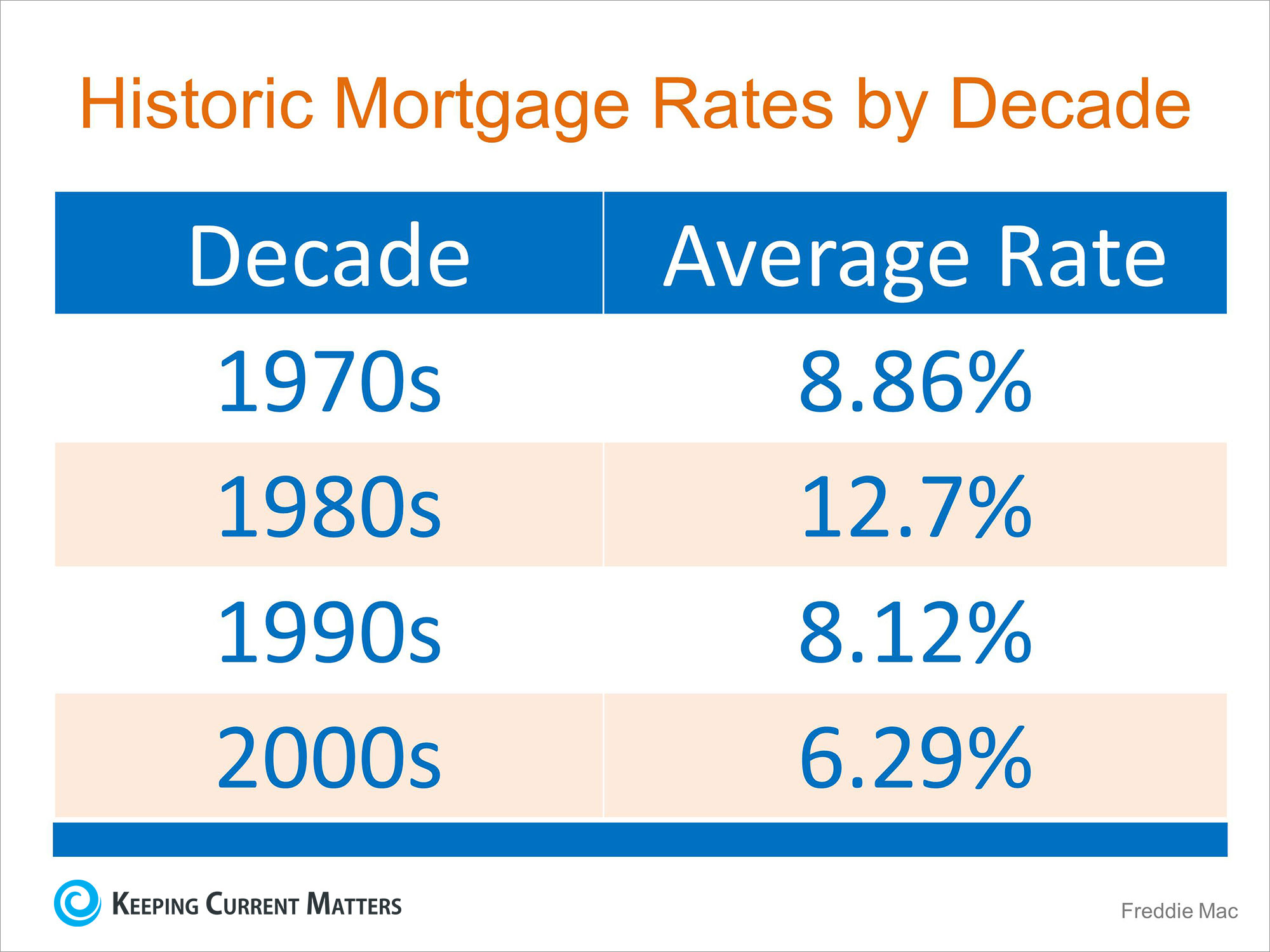
This has caused some purchasers to lament the fact they may no longer be able to get a rate below 4%. However, we must realize that current rates are still at historic lows.

Here is a chart showing the average mortgage interest rate over the last several decades.

Mortgage Interest Rates Went Up Again… Should I Wait to Buy? | Keeping Current Matters

Bottom Line

Though you may have missed getting the lowest mortgage rate ever offered, you can still get a better interest rate than your older brother or sister did ten years ago, a lower rate than your parents did twenty years ago, and a better rate than your grandparents did forty years ago.

Posted in Getting a loan
June 11, 2017

A Tale of Two Markets: Inventory Mismatch Paints a More Detailed Picture

A Tale of Two Markets: Inventory Mismatch Paints a More Detailed Picture | Keeping Current Matters

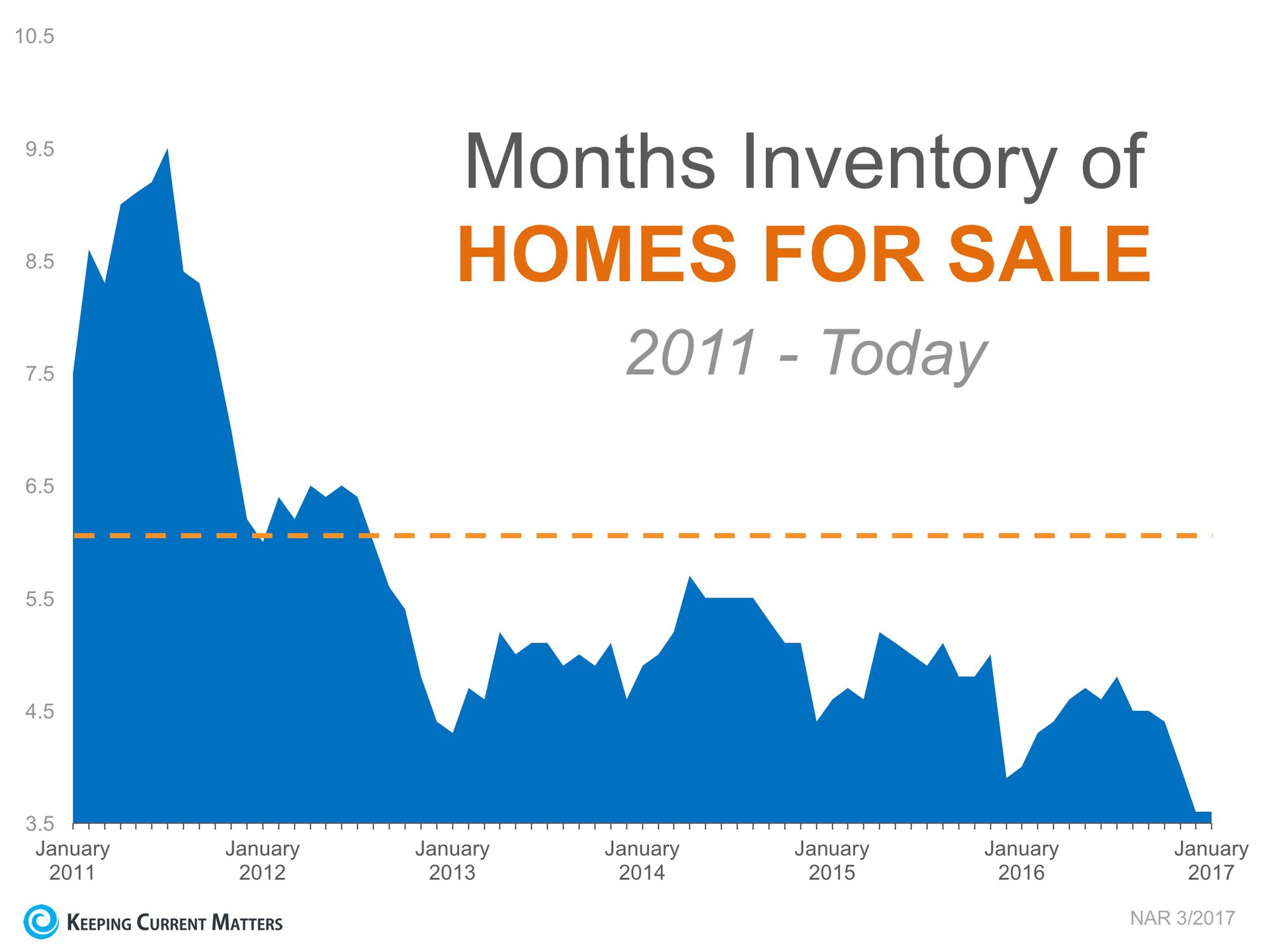
The inventory of existing homes for sale in today’s market was recently reported to be at a 3.6-month supply according to the National Association of Realtors latest Existing Home Sales Report. Inventory is now 7.1% lower than this time last year, marking the 20th consecutive month of year-over-year drops.

Historically, inventory must reach a 6-month supply for a normal market where home prices appreciate with inflation. Anything less than a 6-month supply is a sellers’ market, where the demand for houses outpaces supply and prices go up.

As you can see from the chart below, the United States has been in a sellers’ market since August 2012, but last month’s numbers reached a new low.

A Tale of Two Markets: Inventory Mismatch Paints a More Detailed Picture | Keeping Current Matters

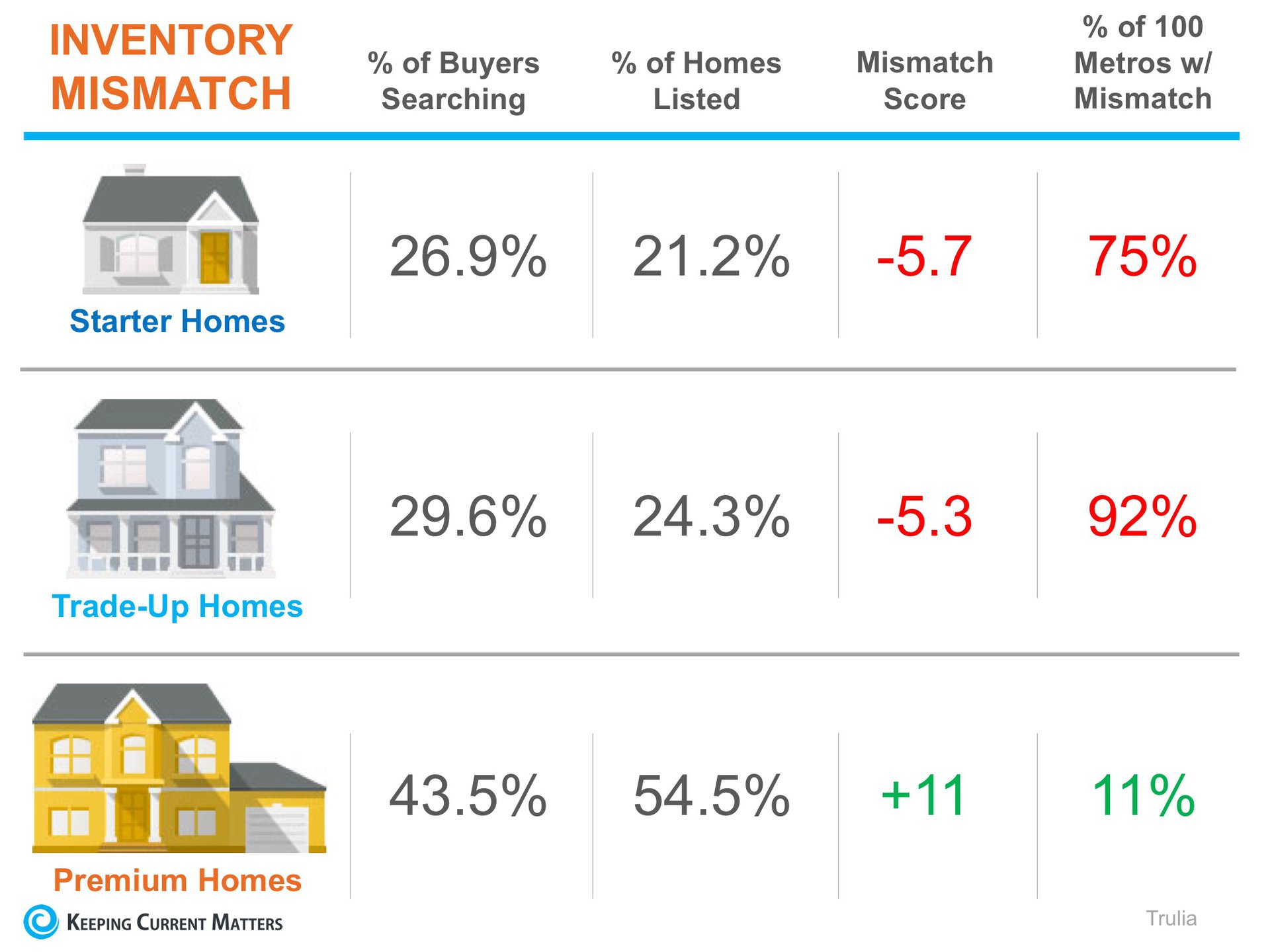
Recently Trulia revealed that not only is there a shortage of homes on the market in general, but the homes that are available for sale are not meeting the needs of the buyers that are searching.

Homes are generally bucketed into three groups by price range: starter, trade-up, and premium.

Trulia’s market mismatch score measures the search interest of buyers against the category of homes that are available on the market. For example: “if 60% of buyers are searching for starter homes but only 40% of listings are starter homes, [the] market mismatch score for starter homes would be 20.”

The results of their latest analysis are detailed in the chart below.

A Tale of Two Markets: Inventory Mismatch Paints a More Detailed Picture | Keeping Current Matters

Nationally, buyers are searching for starter and trade-up homes and are coming up short with the listings available, leading to a highly competitive seller’s market in these categories. Ninety-two of the top 100 metros have a shortage in trade-up inventory.

Premium homebuyers have the best chance of less competition and a surplus of listings in their price range with an 11-point surplus, leading to more of a buyer’s market.

“It leaves Americans who are in the market for a home increasingly chasing too fewer options in lower price ranges, and sellers of premium homes more likely to be left waiting longer for a buyer.”

 Lawrence Yun, NAR’s Chief Economist doesn’t see an end to this coming any time soon: 

“Competition is likely to heat up even more heading into the spring for house hunters looking for homes in the lower- and mid-market price range.”

Bottom Line

Real estate is local. If you are thinking about buying OR selling this spring, sit with a local real estate professional who can share with you the exact market conditions in your area

Posted in Market Conditions
June 11, 2017

Which Homes Have Appreciated the Most?

Which Homes Have Appreciated the Most? | Keeping Current Matters

Home values have risen dramatically over the last twelve months. The latest Existing Home Sales Report from the National Association of Realtors puts the annual increase in the median existing-home price at 7.1%. CoreLogic, in their most recent Home Price Insights Report, reveals that national home prices have increased by 6.9% year-over-year.

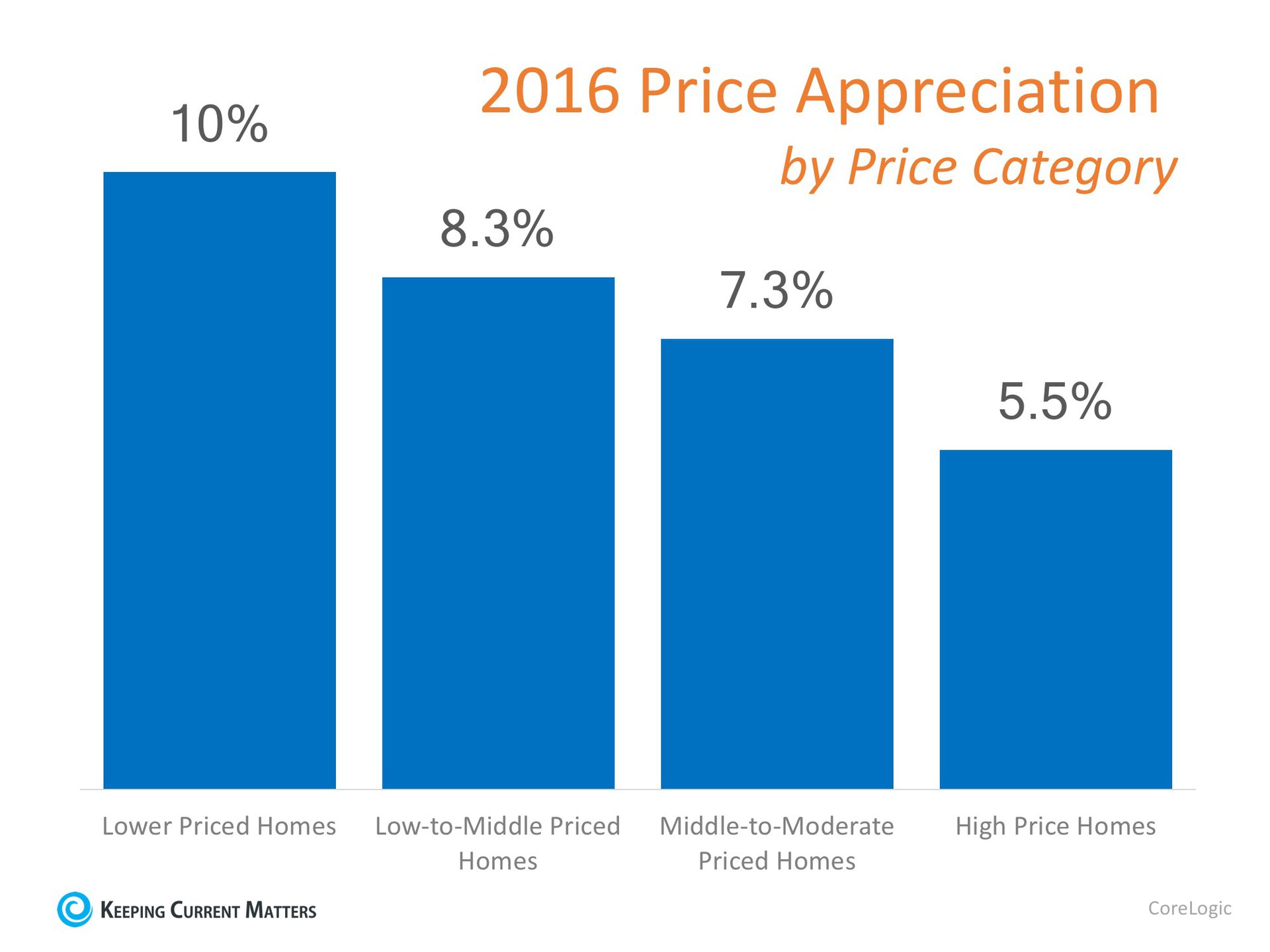
The CoreLogic report broke down appreciation even further into four different price categories:

  1. Lower Priced Homes: priced at 75% or less of the median
  2. Low-to-Middle Priced Homes: priced between 75-100% of the median
  3. Middle-to-Moderate Priced Homes: priced between 100-125% of the median
  4. High Price Homes: priced greater than 125% of the median

Here is how each category did in 2016:

Which Homes Have Appreciated the Most? | Keeping Current Matters

Bottom Line

The lower priced homes (which are more in demand) appreciated at greater rates than the homes at the upper ends of the spectrum.

Posted in